
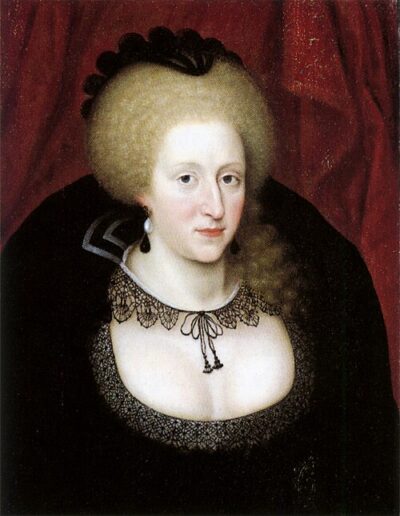
Anne of Denmark
Anne of Denmark was a Queen consort of James VI of Scots, I of England. Born December 12, 1574, in Skanderborg. Died March 2, 1619, in Hampton Court Palace.
Facts
31 facts · 2 confirmed by two sources · 11 cited · 17 from one source · 1 where the sources disagree
What’s different
- Born in: we show Skanderborg (Sources disagree). Wikidata also lists Skanderborg Slot
Where this comes from
Papalocal keeps its own record. It started from these sources; what each one said is kept here as it was copied, so a change on their side never changes this page by itself. Tap one to read its version.
What Wikidata says · copied November 16, 2026 · revision 2568906829
- Described as
- Queen consort of James VI of Scots, I of England (1574-1619)
- Other names
- Queen Anne
- Born
- December 12, 1574 · 1 reference
- Died
- March 2, 1619 · 5 references
- Born in
- Skanderborg Slot; Skanderborg · 1 reference
- Died in
- Hampton Court Palace
- Buried in
- Westminster Abbey
- Cause of death
- edema
- Citizen of
- Kingdom of Scotland; Kingdom of Denmark
- Occupation
- consort; aristocrat; philanthropist; patron of the arts · 1 reference
- Spouse
- James VI and I (1589–1619) · 2 references
- Children
- Henry Frederick, Prince of Wales · 3 references; Elizabeth Stuart, Queen of Bohemia · 2 references; Charles I of England · 2 references; Mary Stuart; unnamed son Stuart · 1 reference; Margaret Stuart · 1 reference; Robert Stuart, Duke of Kintyre and Lorne · 1 reference; unnamed son Stuart · 1 reference; Sophia of England · 1 reference
- Father
- Frederick II of Denmark · 1 reference
- Mother
- Sophie of Mecklenburg-Güstrow
- Siblings
- Christian IV of Denmark; John, Prince of Schleswig-Holstein; Ulrik of Denmark; Elizabeth of Denmark, Duchess of Brunswick-Wolfenbüttel; Augusta of Denmark; Hedwig of Denmark
- Religion
- Lutheranism
- Wikipedias with a page
- 49
Wikidata item Q158248 (wikidata.org/wiki/Q158248), public domain (CC0). Copied November 16, 2026.
What Wikipedia says · copied November 16, 2026 · revision 1384416351
Anne of Denmark (Danish: Anna; 12 December 1574 – 2 March 1619) was Queen of Scotland from her marriage to King James VI on 20 August 1589, and Queen of England and Ireland from the union of the Scottish and English Crowns on 24 March 1603, until her death in 1619.
The second daughter of King Frederick II of Denmark and Sophie of Mecklenburg-Güstrow, Anne married James at age 14. They had three children who survived infancy: Henry Frederick, Prince of Wales, who predeceased his parents; Princess Elizabeth, who became Queen of Bohemia; and James's future successor, Charles I. Anne demonstrated an independent streak and a willingness to use factional Scottish politics in her conflicts with James over the custody of Prince Henry and his treatment of her friend Beatrix Ruthven. Anne appears to have loved James at first, but the couple gradually drifted and eventually lived apart, though mutual respect and a degree of affection survived.
In England, Anne shifted her energies from factional politics to patronage of the arts and constructed her own magnificent court, hosting one of the richest cultural salons in Europe. After 1612, she had sustained bouts of ill health and gradually withdrew from the centre of court life. Though she was reported to have been a Protestant at the time of her death, she may have converted to Catholicism at some point.
Some historians have dismissed Anne as frivolous and self-indulgent. However, 18th-century writers including Thomas Birch and William Guthrie considered her a woman of "boundless intrigue". Recent reappraisals acknowledge Anne's assertive independence and, in particular, her dynamic significance as a patron of the arts during the Jacobean age.
- Born, in its opening lines
- December 12, 1574
- Died, in its opening lines
- March 2, 1619
From the Wikipedia article “Anne of Denmark” (en.wikipedia.org/wiki/Anne_of_Denmark), by its contributors, under CC BY-SA 4.0 (creativecommons.org/licenses/by-sa/4.0/). Copied November 16, 2026; not changed.
Confirmed Two sources agree. Cited One source, and it names where it got it. One source One source, without a reference of its own. Sources disagree The sources disagree. We show the best-supported value and keep theirs below.
