
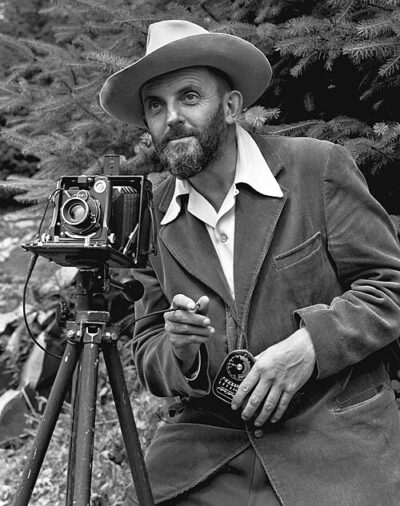
Ansel Adams
Ansel Adams was an American photographer and environmentalist. Born February 20, 1902, in San Francisco. Died April 22, 1984, in Carmel-by-the-Sea. Known for Moonrise, Hernandez, New Mexico and The Tetons and the Snake River. Awards include Guggenheim Fellowship, Hasselblad Award and Presidential Medal of Freedom.

Facts
31 facts · 2 confirmed by two sources · 13 cited · 16 from one source
Where this comes from
Papalocal keeps its own record. It started from these sources; what each one said is kept here as it was copied, so a change on their side never changes this page by itself. Tap one to read its version.
What Wikipedia says · copied November 13, 2026 · revision 1382715158
Ansel Easton Adams (February 20, 1902 – April 22, 1984) was an American landscape photographer and environmentalist known for his black-and-white images of the American West. He helped found Group f/64, an association of photographers advocating "pure" photography which favored sharp focus and the use of the full tonal range of a photograph. He and Fred Archer developed a system of image-making called the Zone System, a method of achieving a desired final print through a technical understanding of how the tonal range of an image is the result of choices made in exposure, negative development, and printing.
Adams was a life-long advocate for environmental conservation, and his photographic practice was deeply entwined with this advocacy. At age 14, he was given his first camera during his first visit to Yosemite National Park. He developed his early photographic work as a member of the Sierra Club. He was later contracted with the United States Department of the Interior to make photographs of national parks. For his work and his persistent advocacy, which helped expand the National Park system, he was awarded the Presidential Medal of Freedom in 1980.
In the founding and establishment of the photography department at the Museum of Modern Art in New York City, an important landmark in securing photography's institutional legitimacy, Adams was a key advisor. He assisted the staging of that department's first photography exhibition, helped to found the photography magazine Aperture, and co-founded the Center for Creative Photography at the University of Arizona.
- Born, in its opening lines
- February 20, 1902
- Died, in its opening lines
- April 22, 1984
From the Wikipedia article “Ansel Adams” (en.wikipedia.org/wiki/Ansel_Adams), by its contributors, under CC BY-SA 4.0 (creativecommons.org/licenses/by-sa/4.0/). Copied November 13, 2026; not changed.
What Wikidata says · copied November 14, 2026 · revision 2568965482
- Described as
- American photographer and environmentalist (1902–1984)
- Other names
- Ansel Easton Adams, Ansel Easton Adams II, Ansel E. Adams
- Born
- February 20, 1902 · 15 references
- Died
- April 22, 1984 · 12 references
- Born in
- San Francisco · 3 references
- Died in
- Carmel-by-the-Sea · 2 references
- Cause of death
- rare circulatory system disease
- Citizen of
- United States · 1 reference
- Occupation
- photographer · 5 references; pianist · 1 reference; writer · 1 reference; mountaineer; university teacher; environmentalist · 1 reference; documentary photographer
- Worked for
- United States Department of the Interior · 1 reference
- Member of
- American Academy of Arts and Sciences; Group f/64 · 1 reference
- Sport
- mountaineering
- Genre
- landscape painting · 1 reference
- Instrument
- piano
- Known for
- Moonrise, Hernandez, New Mexico · 1 reference; The Tetons and the Snake River
- Awards
- Guggenheim Fellowship (1946) · 1 reference; Hasselblad Award (1981) · 1 reference; Presidential Medal of Freedom (1980) · 1 reference; California Hall of Fame (2007); John Muir Award (1963); Progress Medal (1969); Fellow of the American Academy of Arts and Sciences
- Field
- photography · 1 reference
- Father
- Charles Hitchcock Adams
- Website
- https://www.anseladams.com/
- Wikipedias with a page
- 69
Wikidata item Q60809 (wikidata.org/wiki/Q60809), public domain (CC0). Copied November 14, 2026.
Confirmed Two sources agree. Cited One source, and it names where it got it. One source One source, without a reference of its own. Sources disagree The sources disagree. We show the best-supported value and keep theirs below.
