
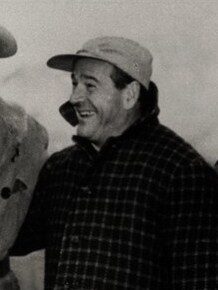
Anthony Mann
Anthony Mann was an American film director. Born June 30, 1906, in San Diego. Died April 29, 1967, in Berlin. Known for The Furies, Winchester '73 and Side Street. Educated at Central High School. Awards include star on Hollywood Walk of Fame.
Facts
26 facts · 2 confirmed by two sources · 5 cited · 19 from one source
Where this comes from
Papalocal keeps its own record. It started from these sources; what each one said is kept here as it was copied, so a change on their side never changes this page by itself. Tap one to read its version.
What Wikidata says · copied November 13, 2026 · revision 2559308396
- Described as
- American film director (1906–1967)
- Other names
- Anton Bundsmann
- Born
- June 30, 1906 · 7 references
- Died
- April 29, 1967 · 7 references
- Born in
- San Diego · 2 references
- Died in
- Berlin · 2 references
- Buried in
- Golders Green Crematorium · 1 reference
- Cause of death
- myocardial infarction
- Citizen of
- United States
- Occupation
- film director · 1 reference; screenwriter · 1 reference; film producer · 1 reference; theatre director · 1 reference; director · 1 reference
- Education
- Central High School · 1 reference
- Known for
- The Furies (1950); Winchester '73 (1950); Side Street (1950); Devil's Doorway (1950); Bend of the River (1952); The Naked Spur (1953); The Far Country (1954); The Man from Laramie (1955); The Tin Star (1957); Men in War (1957)
- Awards
- star on Hollywood Walk of Fame · 1 reference
- Spouse
- Sara Montiel (1957–1963); Mildred Manning (1936–1957)
- Wikipedias with a page
- 41
Wikidata item Q269975 (wikidata.org/wiki/Q269975), public domain (CC0). Copied November 13, 2026.
What Wikipedia says · copied November 13, 2026 · revision 1381440193
Anthony Mann (born Emil Anton Bundsmann; June 30, 1906 – April 29, 1967) was an American film director and stage actor. He came to prominence as a skilled director of film noir and Westerns, and for his historical epics.
Mann started as a theatre actor appearing in numerous stage productions. In 1937, he moved to Hollywood where he worked as a talent scout and casting director. He then became an assistant director, most notably working for Preston Sturges. His directorial debut was Dr. Broadway (1942). He directed several feature films for numerous production companies, including RKO Pictures, Eagle-Lion Films, Universal Pictures, and Metro-Goldwyn-Mayer (MGM). His first major success was T-Men (1947), garnering notable recognition for producing several films in the film noir genre through modest budgets and short shooting schedules. As a director, he often collaborated with cinematographer John Alton.
During the 1950s, Mann shifted to directing Western films starring several major stars of the era, including James Stewart. He directed Stewart in eight films, including Winchester '73 (1950), The Naked Spur (1953), and The Man from Laramie (1955). While successful in the United States, these films became appreciated and studied among French film critics, several of whom would become influential with the French New Wave. In 1955, Jacques Rivette hailed Mann as "one of the four great directors of postwar Hollywood". The other three were Nicholas Ray, Richard Brooks, and Robert Aldrich.
By the 1960s, Mann turned to large-scale filmmaking, directing the medieval epic El Cid (1961), starring Charlton Heston and Sophia Loren, and The Fall of the Roman Empire (1964). Both films were produced by Samuel Bronston. Mann then directed the war film The Heroes of Telemark (1965) and the spy thriller A Dandy in Aspic (1968). In 1967, Mann died from a heart attack in Berlin before he had finished the latter film; its star Laurence Harvey completed the film, albeit uncredited.
- Born, in its opening lines
- June 30, 1906
- Died, in its opening lines
- April 29, 1967
From the Wikipedia article “Anthony Mann” (en.wikipedia.org/wiki/Anthony_Mann), by its contributors, under CC BY-SA 4.0 (creativecommons.org/licenses/by-sa/4.0/). Copied November 13, 2026; not changed.
Confirmed Two sources agree. Cited One source, and it names where it got it. One source One source, without a reference of its own. Sources disagree The sources disagree. We show the best-supported value and keep theirs below.
