
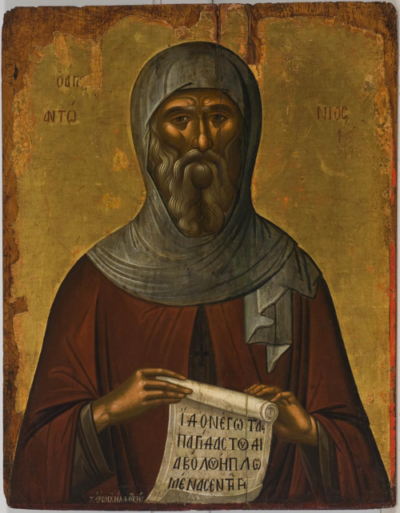
Anthony the Great
Anthony the Great was an Egyptian Christian monk, hermit, and saint (died 356). Born 251, in Coma. Died 357, in Thebes.
Facts
10 facts · 1 confirmed by two sources · 4 cited · 4 from one source · 1 where the sources disagree
What’s different
- Died: we show 357 (Sources disagree). Wikipedia says January 17, 356
Where this comes from
Papalocal keeps its own record. It started from these sources; what each one said is kept here as it was copied, so a change on their side never changes this page by itself. Tap one to read its version.
What Wikidata says · copied November 16, 2026 · revision 2567756582
- Described as
- Egyptian Christian monk, hermit, and saint (died 356)
- Other names
- Saint Anthony Abbot, St. Anthony the Great, Antonius abbas, Saint Anthony of Egypt, the Great, Saint Antony, the Great, Saint Anthony, St. Anthony of Egypt, Antonius Magnus, the Hermit, Saint Anthony, Saint Anthony, St. Anthony, St Anthony
- Born
- 251 · 4 references
- Died
- 357 · 2 references
- Born in
- Coma · 3 references
- Died in
- Thebes
- Citizen of
- Ancient Rome
- Occupation
- Christian monk · 2 references; anchorite; writer · 2 references
- Religion
- Christianity · 2 references
- Lived in
- Dayr al-Maymun (286–305) · 1 reference
- Wikipedias with a page
- 78
Wikidata item Q170547 (wikidata.org/wiki/Q170547), public domain (CC0). Copied November 16, 2026.
What Wikipedia says · copied November 16, 2026 · revision 1381774565
Anthony the Great (c. 12 January 251 – 17 January 356) was an Egyptian Christian monk, revered since his death as a saint. He is distinguished from other saints named Anthony, such as Anthony of Padua, by various epithets: Anthony of Egypt, Anthony the Abbot, Anthony of the Desert, Anthony the Anchorite, Anthony the Hermit, and Anthony of Thebes. For his importance among the Desert Fathers and to all later Christian monasticism, he is also known as the Father of All Monks. His feast day is celebrated on 17 January among the Eastern Orthodox and Catholic churches and on Tobi 22 in the Coptic calendar.
The biography of Anthony's life by Athanasius of Alexandria helped to spread the concept of Christian monasticism, particularly in Western Europe via its Latin translations. He is often erroneously considered the first Christian monk, but as his biography and other sources make clear, there were many ascetics before him. Anthony was, however, among the first known to go into the wilderness (about AD 270), which seems to have contributed to his renown. Accounts of Anthony enduring supernatural temptation during his sojourn in the Eastern Desert of Egypt inspired the depiction of his temptations in visual art and literature.
Anthony is invoked against infectious diseases, particularly skin diseases. In the past, many such afflictions, including ergotism, erysipelas, and shingles, were referred to as Saint Anthony's fire.
- Born, in its opening lines
- January 12, 251
- Died, in its opening lines
- January 17, 356
From the Wikipedia article “Anthony the Great” (en.wikipedia.org/wiki/Anthony_the_Great), by its contributors, under CC BY-SA 4.0 (creativecommons.org/licenses/by-sa/4.0/). Copied November 16, 2026; not changed.
Confirmed Two sources agree. Cited One source, and it names where it got it. One source One source, without a reference of its own. Sources disagree The sources disagree. We show the best-supported value and keep theirs below.
