
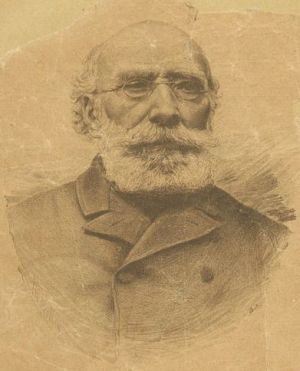
Antoine Béchamp
Antoine Béchamp was a French scientist. Born October 15, 1816, in Bassing. Died April 15, 1908, in Paris. Positions held include dean (1876–1888). Educated at University of Strasbourg. Awards include Knight of the Legion of Honour.
Facts
15 facts · 1 confirmed by two sources · 6 cited · 7 from one source · 1 where the sources disagree
What’s different
- Born: we show October 15, 1816 (Sources disagree). Wikipedia says October 16, 1816
Where this comes from
Papalocal keeps its own record. It started from these sources; what each one said is kept here as it was copied, so a change on their side never changes this page by itself. Tap one to read its version.
What Wikidata says · copied November 18, 2026 · revision 2559623562
- Described as
- French scientist (1816–1908)
- Other names
- Antoine Bechamp
- Born
- October 15, 1816 · 2 references
- Died
- April 15, 1908 · 5 references
- Born in
- Bassing · 1 reference
- Died in
- Paris · 1 reference
- Citizen of
- France
- Occupation
- biologist · 1 reference; chemistry teacher · 1 reference
- Positions held
- dean (1876–1888)
- Worked for
- Faculty of Medicine of Montpellier (1856–1876) · 1 reference; Université de Lille. Faculté de médecine (1877–1886) · 1 reference
- Education
- University of Strasbourg · 1 reference
- Member of
- Académie Nationale de Médecine; Romanian Academy
- Awards
- Knight of the Legion of Honour
- Children
- Joseph Béchamp
- Wikipedias with a page
- 22
Wikidata item Q81127 (wikidata.org/wiki/Q81127), public domain (CC0). Copied November 18, 2026.
What Wikipedia says · copied November 18, 2026 · revision 1381110328
Pierre Jacques Antoine Béchamp (French pronunciation: [pjɛʁ ʒak ɑ̃twan beʃɑ̃]; 16 October 1816 – 15 April 1908) was a French scientist now best known for breakthroughs in synthetic organic chemistry and for an impassioned rivalry with Louis Pasteur.
Béchamp developed the Béchamp reduction, an inexpensive method to produce aniline dye, permitting William Henry Perkin to launch the synthetic-dye industry. Béchamp also synthesized the first organic arsenical drug, arsanilic acid, from which Paul Ehrlich later synthesized salvarsan, the first chemotherapeutic drug.
Béchamp's rivalry with Pasteur was initially for priority in attributing fermentation to microorganisms, later for attributing the silkworm disease pebrine to microorganisms, and eventually over the validity of germ theory.
Béchamp claimed to have discovered that the "molecular granulations" in biological fluids were actually the elementary units of life. He named them microzymas—that is, "tiny enzymes"—and credited them with producing both enzymes and cells while "evolving" amid favorable conditions into multicellular organisms. Béchamp also denied that bacteria could invade a healthy animal and cause disease, claiming instead that unfavorable host and environmental conditions destabilize the host's native microzymas and decompose host tissue by producing pathogenic bacteria.
While cell theory and germ theory gained widespread acceptance, granular theories have been rejected by current scientific consensus. Béchamp's version, microzymian theory, has been retained by small groups, especially in alternative medicine. His work in understanding how the "terrain" may affect disease may have implications in emerging microbiome research.
- Born, in its opening lines
- October 16, 1816
- Died, in its opening lines
- April 15, 1908
From the Wikipedia article “Antoine Béchamp” (en.wikipedia.org/wiki/Antoine_Béchamp), by its contributors, under CC BY-SA 4.0 (creativecommons.org/licenses/by-sa/4.0/). Copied November 18, 2026; not changed.
Confirmed Two sources agree. Cited One source, and it names where it got it. One source One source, without a reference of its own. Sources disagree The sources disagree. We show the best-supported value and keep theirs below.
