
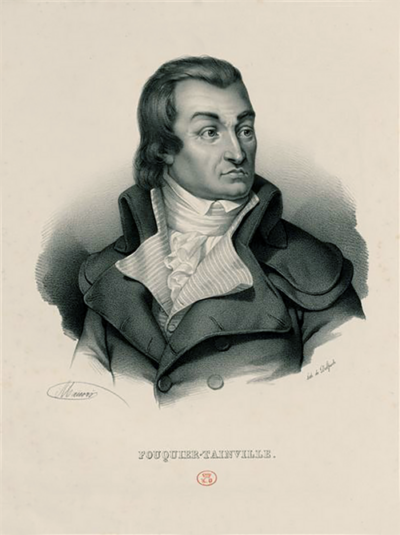
Antoine Quentin Fouquier-Tinville
Antoine Quentin Fouquier-Tinville was a French lawyer during the French Revolution and Reign of Terror. Born June 10, 1746, in Foreste. Died May 7, 1795, in Paris. Positions held include Accusateur public.
Facts
16 facts · 2 confirmed by two sources · 5 cited · 9 from one source
Where this comes from
Papalocal keeps its own record. It started from these sources; what each one said is kept here as it was copied, so a change on their side never changes this page by itself. Tap one to read its version.
What Wikidata says · copied November 17, 2026 · revision 2557780186
- Described as
- French lawyer during the French Revolution and Reign of Terror (1746-1795)
- Other names
- Fouquier-Tinville, Antoine Quentin Fouquier de Tinville
- Born
- June 10, 1746 · 2 references
- Died
- May 7, 1795 · 6 references
- Born in
- Foreste
- Died in
- Paris · 1 reference
- Buried in
- Errancis Cemetery
- Cause of death
- decapitation
- Name at birth
- Antoine Quentin Fouquier de Tinville
- Citizen of
- France
- Occupation
- magistrate; lawyer · 1 reference; politician · 1 reference; civil servant · 1 reference
- Positions held
- Accusateur public
- Field
- politics · 1 reference; public action · 1 reference
- Siblings
- Pierre-Éloi Fouquier d'Hérouël
- Wikipedias with a page
- 26
Wikidata item Q453302 (wikidata.org/wiki/Q453302), public domain (CC0). Copied November 17, 2026.
What Wikipedia says · copied November 17, 2026 · revision 1381621909
Antoine Quentin Fouquier de Tinville (French pronunciation: [ɑ̃twan kɑ̃tɛ̃ fukje tɛ̃vil], 10 June 1746 – 7 May 1795), also called Fouquier-Tinville and nicknamed posthumously the Provider of the Guillotine was a French lawyer and accusateur public (public prosecutor) of the Revolutionary Tribunal during the French Revolution and Reign of Terror.
From March 1793 he served as the public prosecutor in Paris, demanding the execution of numerous accused individuals, including such famous persons as Marie-Antoinette, Danton and Robespierre. He oversaw the sentencing of over two thousand people to the guillotine. In April 1794, it was decreed to centralise the investigation of court records and to bring all the political suspects in France to the Revolutionary Tribunal to Paris. Following the events of 10 Thermidor, he was arrested in early August.
He was tried by the Revolutionary Tribunal as one of the major figures responsible for the excesses and injustices that marked the period of the Reign of Terror. During his trial, he defended himself by stating, "It is not I who ought to be facing the tribunal, but the chiefs whose orders I have executed. I had only acted in the spirit of the laws passed by a Convention invested with all powers." Generally, his defense involved shifting the blame for the executions onto the Committee of Public Safety, especially on Maximilien de Robespierre.
Despite this defense, he was sentenced to death, alongside the judges and some jurors of the Revolutionary Tribunal, among other charges, for abusing his authority and neglecting proper legal procedures during trials. He was guillotined in Paris on 7 May 1795, and became the last individual to be executed by the Revolutionary Tribunal before its abolition.
His precise role in the Reign of Terror is still a subject of debate; modern historians suggest that it is more valuable to view his role as part of a group of officials and various terrorist actors rather than solely as the sole instigator of the Judicial Terror.
- Born, in its opening lines
- June 10, 1746
- Died, in its opening lines
- May 7, 1795
From the Wikipedia article “Antoine Quentin Fouquier-Tinville” (en.wikipedia.org/wiki/Antoine_Quentin_Fouquier-Tinville), by its contributors, under CC BY-SA 4.0 (creativecommons.org/licenses/by-sa/4.0/). Copied November 17, 2026; not changed.
Confirmed Two sources agree. Cited One source, and it names where it got it. One source One source, without a reference of its own. Sources disagree The sources disagree. We show the best-supported value and keep theirs below.
