
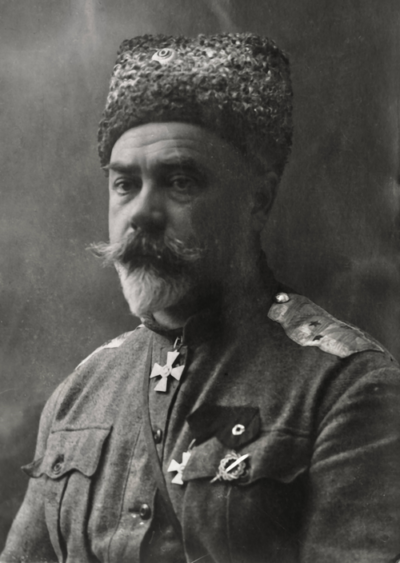
Anton Denikin
Anton Denikin was a Russian military and political leader. Born December 16, 1872, in Szpetal. Died August 8, 1947, in Ann Arbor. Positions held include Armed Forces of South Russia. Educated at Military Academy of the General Staff of the Armed Forces of Russia and Military Institute of Telecommunications and Informatization. Awards include Croix de guerre 1914–1918, Knight Commander of the Order of the Bath and Order of St. Anna 2nd class with swords.
Facts
36 facts · 1 confirmed by two sources · 7 cited · 26 from one source · 2 where the sources disagree
What’s different
- Died: we show August 8, 1947 (Sources disagree). Wikipedia says August 7, 1947
- Buried in: we show Donskoy Monastery (Sources disagree). Wikidata also lists New Donskoe cemetery
Where this comes from
Papalocal keeps its own record. It started from these sources; what each one said is kept here as it was copied, so a change on their side never changes this page by itself. Tap one to read its version.
What Wikidata says · copied November 16, 2026 · revision 2569057357
- Described as
- Russian military and political leader (1872–1947)
- Other names
- Anton Ivanovich Denikin
- Born
- December 16, 1872 · 5 references
- Died
- August 8, 1947 · 6 references
- Born in
- Szpetal · 1 reference
- Died in
- Ann Arbor · 2 references
- Buried in
- New Donskoe cemetery; Donskoy Monastery · 1 reference
- Citizen of
- Russian Empire
- Occupation
- military officer · 1 reference; writer; politician · 1 reference; lieutenant general · 1 reference
- Positions held
- Armed Forces of South Russia
- Political party
- White movement · 1 reference
- Education
- Military Academy of the General Staff of the Armed Forces of Russia; Military Institute of Telecommunications and Informatization
- Awards
- Croix de guerre 1914–1918 (1917); Knight Commander of the Order of the Bath (1919); Order of St. Anna 2nd class with swords (1905) · 1 reference; Order of St. Anne 3rd class with swords and bow (1904) · 1 reference; Order of Saint Stanislaus, 2nd class (1904); Order of St. Vladimir, 4th class (1909); Order of Saint Stanislaus, 3rd class (1902); Order of St. Vladimir, 3rd class (1914); Order of Michael the Brave, 3rd class (1917); Order of St. George, 3rd class (1915); Order of St. George, 4th class (1915); Gold Sword for Bravery (1915) · 1 reference; Medal "In memory of the 300th anniversary of Romanov dynasty" (1913); Medal 100 year 1812 (1912); Order of Saint Stanislaus, 2nd class with swords · 1 reference
- Spouse
- Xenia Denikina
- Children
- Marina Denikina
- Father
- Ivan Efimovich Denikin
- Mother
- Elizaveta Fyodorovna Denikin
- Religion
- Eastern Orthodoxy · 1 reference
- Military branch
- infantry
- Military rank
- lieutenant general (1915–)
- Wikipedias with a page
- 61
Wikidata item Q108314 (wikidata.org/wiki/Q108314), public domain (CC0). Copied November 16, 2026.
What Wikipedia says · copied November 16, 2026 · revision 1378458084
Anton Ivanovich Denikin (Russian: Анто́н Ива́нович Дени́кин; 16 December [O.S. 4 December] 1872 – 7 August 1947) was a Russian military officer who served as a lieutenant general in the Imperial Russian Army and as a leading commander of the anti-Bolshevik White movement during the Russian Civil War.
A veteran of the Russo-Japanese War and a highly decorated commander in World War I, Denikin rose to prominence for his leadership of the "Iron Brigade". Following the February Revolution, he became a vocal critic of the Russian Provisional Government's military policies. After the October Revolution, he was a co-founder of the anti-Bolshevik Volunteer Army in South Russia. He assumed command of the army in April 1918 and became the Commander-in-Chief of the Armed Forces of South Russia (AFSR) in January 1919.
In mid-1919, Denikin's forces launched the Moscow offensive, a major assault that captured large swathes of territory and advanced to within 350 kilometres (220 miles) of the capital, representing the high-water mark of the White movement. However, the offensive was ultimately defeated by a Red Army counter-attack. The defeat was attributed to several factors, including overstretched supply lines and the White movement's political failures. Denikin's government, the Special Council, failed to implement an effective land reform policy to win the support of the peasantry, while its uncompromising slogan of "a great, united, and indivisible Russia" alienated potential allies, including the Cossacks and various national minorities. The territories under Denikin's control were also ravaged by waves of brutal antisemitic pogroms, which he failed to suppress, discrediting the movement internationally and eroding its internal discipline.
After a disastrous retreat, Denikin resigned his command to General Pyotr Wrangel in April 1920 and went into exile. He lived in France and, after World War II, in the United States. He dedicated his life in exile to writing, producing a multi-volume memoir, The Russian Turmoil, and other historical works. A staunch Russian patriot and an opponent of communism, Denikin urged Russian émigrés to support the Red Army in defending their homeland against Nazi Germany during World War II. He remains a controversial figure in Russian history, remembered for his military skill and personal courage, but criticized as an inflexible and politically inept leader whose defeat was a crucial factor in the Bolshevik victory.
- Born, in its opening lines
- December 16, 1872
- Died, in its opening lines
- August 7, 1947
From the Wikipedia article “Anton Denikin” (en.wikipedia.org/wiki/Anton_Denikin), by its contributors, under CC BY-SA 4.0 (creativecommons.org/licenses/by-sa/4.0/). Copied November 16, 2026; not changed.
Confirmed Two sources agree. Cited One source, and it names where it got it. One source One source, without a reference of its own. Sources disagree The sources disagree. We show the best-supported value and keep theirs below.
