
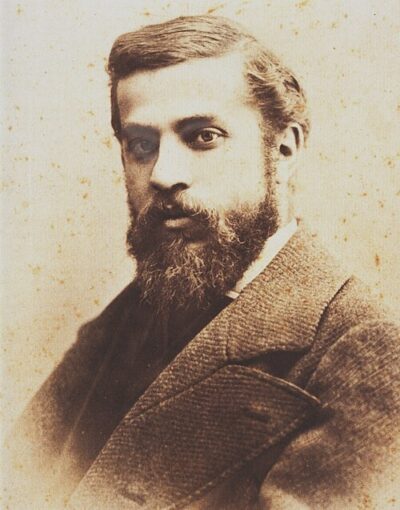
Antoni Gaudí
Antoni Gaudí was a Catalan architect. Born June 25, 1852, in Reus. Died June 10, 1926, in Barcelona. Known for Casa Milà, Basilica and Expiatory Church of the Holy Family and Bellesguard. Educated at Escola Tècnica Superior d'Arquitectura de Barcelona and Escola de la Llotja. Awards include illustrious son.
Facts
28 facts · 2 confirmed by two sources · 15 cited · 11 from one source
Where this comes from
Papalocal keeps its own record. It started from these sources; what each one said is kept here as it was copied, so a change on their side never changes this page by itself. Tap one to read its version.
What Wikidata says · copied November 16, 2026 · revision 2561589736
- Described as
- Catalan architect (1852–1926)
- Other names
- Antonio Gaudí, Gaudí, Antonio Gaudí y Cornet, Antoni Gaudí Jornet, Gaudi, Antoni Gaodi, Antoni Gaudi i Cornet, Antoni Gaudí i Cornet, Antoní Gaudí, Antoni Gaudí Cornet, Antonio Gaudí i Cornet, Antonio Gaudi
- Born
- June 25, 1852 · 14 references
- Died
- June 10, 1926 · 13 references
- Born in
- Reus · 5 references
- Died in
- Barcelona · 5 references
- Buried in
- Basilica and Expiatory Church of the Holy Family · 1 reference
- Cause of death
- tram accident · 2 references
- Citizen of
- Spain · 3 references
- Occupation
- architect · 4 references; designer · 1 reference; drafter
- Education
- Escola Tècnica Superior d'Arquitectura de Barcelona (1872–1876); Escola de la Llotja
- Member of
- Centre Excursionista de Catalunya
- Known for
- Casa Milà · 1 reference; Basilica and Expiatory Church of the Holy Family · 1 reference; Bellesguard; El Capricho · 1 reference; Park Güell · 1 reference; Palacio Episcopal de Astorga · 1 reference; Casa Vicens · 1 reference; Casa de los Botines · 1 reference; Church of Colònia Güell; Casa Batlló · 1 reference
- Awards
- illustrious son
- Field
- architecture · 1 reference; modernism · 1 reference
- Religion
- Roman Catholic; Catholicism
- Wikipedias with a page
- 131
Wikidata item Q25328 (wikidata.org/wiki/Q25328), public domain (CC0). Copied November 16, 2026.
What Wikipedia says · copied November 16, 2026 · revision 1385730809
Antoni Gaudí i Cornet ( gow-DEE or GOW-dee, Catalan: [ənˈtɔni ɣəwˈði j kuɾˈnɛt]; 25 June 1852 – 10 June 1926) was a Spanish architect and designer, widely known as the greatest exponent of Catalan Modernisme. Gaudí's works have a sui generis style, with most located in Barcelona, including his magnum opus, the Sagrada Família church.
Gaudí's work was influenced by his passions in life: architecture, nature, and religion. He considered every detail of his creations and combined crafts such as ceramics, stained glass, wrought ironwork forging, and carpentry. He introduced new techniques in the treatment of materials, such as trencadís which used waste ceramic pieces.
Influenced by neo-Gothic art and Oriental techniques, Gaudí became part of the Modernista movement, which peaked in the late 19th and early 20th centuries. His work eventually transcended mainstream Modernisme, developing into a unique style inspired by natural forms. Gaudí rarely drew detailed plans, preferring to create three-dimensional scale models and mold the details as he conceived them.
Gaudí's work enjoys global admiration and ongoing study. His masterpiece, the still-incomplete Sagrada Família, is the most-visited monument in Spain. Between 1984 and 2005, seven of his works were declared UNESCO World Heritage Sites.
Gaudí's Catholic faith intensified throughout his life, and religious imagery appears in many of his works. This earned him the nickname "God's Architect". His cause for canonisation was opened in the Archdiocese of Barcelona in 2003. Pope Francis authorised Gaudi's declaration as Venerable in April 2025.
- Born, in its opening lines
- June 25, 1852
- Died, in its opening lines
- June 10, 1926
From the Wikipedia article “Antoni Gaudí” (en.wikipedia.org/wiki/Antoni_Gaudí), by its contributors, under CC BY-SA 4.0 (creativecommons.org/licenses/by-sa/4.0/). Copied November 16, 2026; not changed.
Confirmed Two sources agree. Cited One source, and it names where it got it. One source One source, without a reference of its own. Sources disagree The sources disagree. We show the best-supported value and keep theirs below.
