
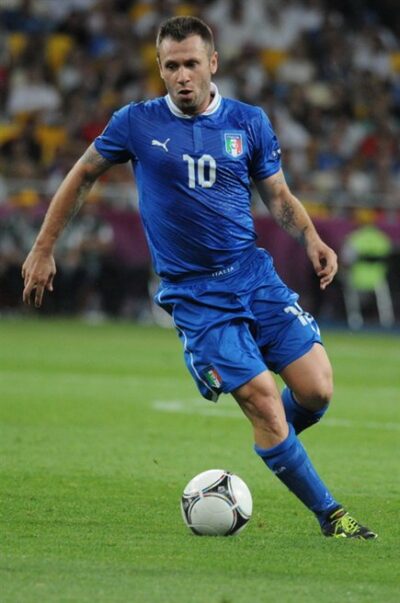
Antonio Cassano
Antonio Cassano is an Italian footballer. Born July 12, 1982, in Bari. Teams include Real Madrid Club de Fútbol (2006–2008), U.C. Sampdoria (2 times) (2007–2016) and Inter Milan (2012–2013).
Facts
22 facts · 1 confirmed by two sources · 1 cited · 20 from one source
Where this comes from
Papalocal keeps its own record. It started from these sources; what each one said is kept here as it was copied, so a change on their side never changes this page by itself. Tap one to read its version.
What Wikidata says · copied November 16, 2026 · revision 2555125338
- Described as
- Italian footballer
- Born
- July 12, 1982 · 3 references
- Born in
- Bari
- Citizen of
- Italy
- Occupation
- association football player (–2018)
- Teams
- Real Madrid Club de Fútbol (2006–2008); U.C. Sampdoria (2 times) (2007–2016); Inter Milan (2012–2013); SSC Bari (1999–2001); AC Milan (2011–2012); AS Roma (2001–2006); Parma Calcio 1913 (2013–2015); Italy national under-18 football team (1999); Italy national under-20 football team (2000); Italy national under-21 football team (2000–2002); Italy men's national association football team (2003–2014); Italy national under-15 football team (1998); Italy national under-16 football team (1998); Hellas Verona FC (2017)
- Sport
- association football
- Spouse
- Carolina Marcialis
- Religion
- atheism
- Height
- 1.75 m (5 ft 9 in) · 1 reference
- Wikipedias with a page
- 59
Wikidata item Q180993 (wikidata.org/wiki/Q180993), public domain (CC0). Copied November 16, 2026.
What Wikipedia says · copied November 16, 2026 · revision 1385549649
Antonio Cassano (Italian pronunciation: [anˈtɔːnjo kasˈsaːno]; born 12 July 1982) is an Italian former professional footballer who played as a forward. A talented and technically gifted player, he was usually deployed as a supporting forward, but could also play as an attacking midfielder, winger, or as a striker. Nicknamed Il Gioiello di Bari Vecchia ("the jewel of Old Bari"), and Fantantonio ("fantastic Antonio"), he was known for his short temper as much as his skill and ability on the pitch. Cassano won an Italian and Spanish league title each throughout his career as major honours.
Cassano began his senior club career with hometown club Bari in 1999; his performances earned him a transfer to Roma two years later, where he won the Supercoppa Italiana and was twice named Serie A Young Footballer of the Year in 2001 and 2003. In 2006, he moved to La Liga club Real Madrid, where he won a league title, but was chastised for his poor behaviour, inconsistent performances, and work-rate, and returned to Italy a year later, on loan to Sampdoria. There, he refound his form, and was signed by the club on a permanent basis in 2008. He then spent single seasons with AC Milan and cross-city rivals Inter Milan, winning a Serie A title and his Supercoppa Italiana with the former, before signing for Parma in 2013. In 2015, he returned to Sampdoria, and in 2017, signed with Verona. He failed to make an appearance for the club and subsequently retired.
At international level, Cassano represented the Italy national football team on 39 occasions between 2003 and 2014, scoring 10 goals; he took part at three UEFA European Championships, and one FIFA World Cup, winning a runners-up medal at UEFA Euro 2012. Along with Mario Balotelli, he is Italy's top-scorer in the UEFA European Championships, with three goals.
Cassano's short temper and disputes with managers and teammates led to birth of the neologism "cassanata" by his former coach, Fabio Capello, in 2002. The word is now regularly used by Italian sports journalists as a euphemism for any behavior incompatible with team spirit.
- Born, in its opening lines
- July 12, 1982
From the Wikipedia article “Antonio Cassano” (en.wikipedia.org/wiki/Antonio_Cassano), by its contributors, under CC BY-SA 4.0 (creativecommons.org/licenses/by-sa/4.0/). Copied November 16, 2026; not changed.
Confirmed Two sources agree. Cited One source, and it names where it got it. One source One source, without a reference of its own. Sources disagree The sources disagree. We show the best-supported value and keep theirs below.
