
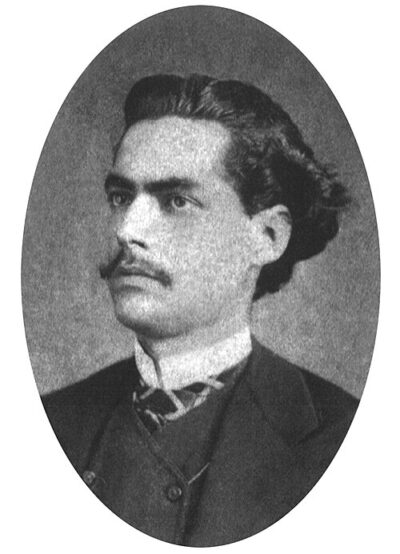
Antônio Frederico de Castro Alves
Antônio Frederico de Castro Alves was a Brazilian poet. Born March 14, 1847, in Muritiba. Died July 6, 1871, in Salvador. Known for Espumas Flutuantes and O Navio Negreiro. Educated at Faculdade de Direito do Recife and Law School of the University of São Paulo.
Facts
17 facts · 2 confirmed by two sources · 3 cited · 12 from one source
Where this comes from
Papalocal keeps its own record. It started from these sources; what each one said is kept here as it was copied, so a change on their side never changes this page by itself. Tap one to read its version.
What Wikidata says · copied November 17, 2026 · revision 2568747832
- Described as
- Brazilian poet (1847-1871)
- Born
- March 14, 1847 · 6 references
- Died
- July 6, 1871 · 6 references
- Born in
- Muritiba · 1 reference
- Died in
- Salvador · 1 reference
- Buried in
- Cemitério do Campo Santo
- Cause of death
- tuberculosis
- Name at birth
- Antônio Frederico de Castro Alves
- Citizen of
- Brazil
- Occupation
- writer; poet · 1 reference
- Education
- Faculdade de Direito do Recife; Law School of the University of São Paulo
- Member of
- Brazilian Academy of Letters
- Known for
- Espumas Flutuantes; O Navio Negreiro
- Siblings
- Amélia de Castro Alves · 1 reference; Adelaide de Castro Alves Guimarães
- Wikipedias with a page
- 26
Wikidata item Q2480182 (wikidata.org/wiki/Q2480182), public domain (CC0). Copied November 17, 2026.
What Wikipedia says · copied November 17, 2026 · revision 1382852866
Antônio Frederico de Castro Alves (14 March 1847 – 6 July 1871) was a Brazilian poet and playwright famous for his abolitionist and republican poems. One of the most famous poets of the Condorist movement, he wrote classics such as Espumas Flutuantes and Hinos do Equador, which elevated him to the position of greatest among his contemporaries, as well as verses from poems such as "Os Escravos" and "A Cachoeira de Paulo Afonso", in addition to the play Gonzaga, which earned him epithets such as "O Poeta dos Escravos" (The Poet of the Slaves) and "republican poet" by Machado de Assis, or descriptions of being "a national poet, if not more, nationalist, social, human and humanitarian poet", in the words of Joaquim Nabuco, of being "the greatest Brazilian poet, lyric and epic", in the words of Afrânio Peixoto, or even of being the "walking apostle of Condorism" and "a volcanic talent, the most enraptured of all Brazilian poets", in the words of José Marques da Cruz. He was part of the romantic movement, being part of what scholars call the "third romantic generation" in Brazil.
Alves began his major production at the age of sixteen, beginning his verses for "Os Escravos" at seventeen (1865), with wide dissemination in the country, where they were published in newspapers and recited, helping to form the generation that would come to achieve the abolition of slavery in the country. Alongside Luís Gama, Nabuco, Ruy Barbosa and José do Patrocínio, he stood out in the abolitionist campaign, "in particular, the figure of the great poet from Bahia Castro Alves". José de Alencar said of him, when he was still alive, that "the powerful feeling of nationality throbs in his work, that soul that makes great poets, like great citizens". His greatest influences were the romantic writers Victor Hugo, Lord Byron, Lamartine, Alfred de Musset and Heinrich Heine.
Historian Armando Souto Maior said that the poet, "as Soares Amora points out 'on the one hand marks the arrival point of romantic poetry, on the other hand he already announces, in some poetic processes, in certain images, in political and social ideas, Realism'. Nevertheless, Alves must be considered the greatest Brazilian romantic poet; his social poetry against slavery galvanized the sensibilities of the time". Manuel Bandeira said that "the only and authentic condor in these bombastic Andes of Brazilian poetry was Castro Alves, a truly sublime child, whose glory is invigorated today by the social intention he put into his work".
In the words of Archimimo Ornelas, "we have Castro Alves, the revolutionary; Castro Alves, the abolitionist; Castro Alves, the republican; Castro Alves, the artist; Castro Alves, the landscaper of American nature; Castro Alves, the poet of youth; Castro Alves, universal poet; Castro Alves, the seer; Castro Alves, the national poet par excellence; finally, in all human manifestations we can find that revolutionary force that was Castro Alves" and, above all, "Castro Alves as the man who loved and was loved".
- Born, in its opening lines
- March 14, 1847
- Died, in its opening lines
- July 6, 1871
From the Wikipedia article “Castro Alves” (en.wikipedia.org/wiki/Castro_Alves), by its contributors, under CC BY-SA 4.0 (creativecommons.org/licenses/by-sa/4.0/). Copied November 17, 2026; not changed.
Confirmed Two sources agree. Cited One source, and it names where it got it. One source One source, without a reference of its own. Sources disagree The sources disagree. We show the best-supported value and keep theirs below.
