
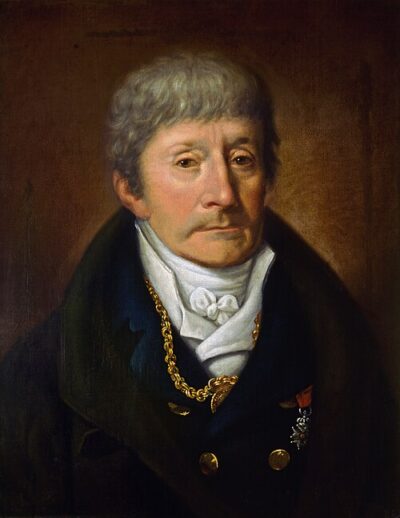
Antonio Salieri
Antonio Salieri was an Italian composer and teacher. Born August 18, 1750, in Legnago. Died May 7, 1825, in Vienna. Positions held include court chapel master (1788–). Known for Europa riconosciuta and Il Moro. Awards include Knight of the Legion of Honour.
Facts
37 facts · 2 confirmed by two sources · 10 cited · 25 from one source
Where this comes from
Papalocal keeps its own record. It started from these sources; what each one said is kept here as it was copied, so a change on their side never changes this page by itself. Tap one to read its version.
What Wikidata says · copied November 16, 2026 · revision 2569817085
- Described as
- Italian composer and teacher (1750–1825)
- Other names
- Salieri, Don Tarar di Palmira
- Born
- August 18, 1750 · 9 references
- Died
- May 7, 1825 · 13 references
- Born in
- Legnago · 3 references; Legnago · 1 reference
- Died in
- Vienna · 7 references
- Buried in
- Vienna Central Cemetery
- Cause of death
- stroke
- Citizen of
- Republic of Venice; Austrian Empire
- Occupation
- composer · 2 references; conductor · 1 reference; musicologist; music educator; chapelmaster · 1 reference; music teacher · 1 reference
- Positions held
- court chapel master (1788–) · 1 reference
- Worked for
- University of Music and Performing Arts Vienna
- Member of
- Ludlamshöhle · 1 reference; Académie des beaux-arts
- Instrument
- pipe organ · 1 reference
- Known for
- Europa riconosciuta; Il Moro
- Awards
- Knight of the Legion of Honour · 1 reference
- Field
- opera; religious music; chamber music
- Spouse
- Therese Helferstorfer
- Children
- Josepha Maria Anna Salieri · 1 reference; Francisca Xaveria Antonia Salieri · 1 reference; Francisca Antonia Salieri · 1 reference; Alois Engelbert Salieri · 1 reference; Maria Anna Theresia Salieri · 1 reference; Elisabetha Josepha Salieri · 1 reference; Catharina Salieri · 1 reference; Theresia Henrica Salieri · 1 reference
- Father
- Antonio Salieri · 1 reference
- Mother
- Anna Maria Scacchi · 1 reference
- Siblings
- Francesco Salieri · 1 reference
- Wikipedias with a page
- 74
Wikidata item Q51088 (wikidata.org/wiki/Q51088), public domain (CC0). Copied November 16, 2026.
What Wikipedia says · copied November 16, 2026 · revision 1384666635
Antonio Salieri (18 August 1750 – 7 May 1825) was an Italian composer and teacher of the classical period.
Salieri was a pivotal figure in the development of late 18th-century opera. A student of Florian Leopold Gassmann and a protégé of Christoph Willibald Gluck, Salieri was a cosmopolitan composer who wrote operas in three languages. He helped to shape operatic compositional vocabulary, and his music was a powerful influence on contemporary composers.
Salieri was born in Legnago, south of Verona, in the Republic of Venice, and spent his adult life and career as a subject of the Habsburg monarchy. Appointed the director of the Italian opera by the Habsburg court at age 24, he dominated Italian-language opera in Vienna until he relinquished the post in 1792. During his career, he also wrote works for opera houses in Paris, Rome, and Venice, and his dramatic works were widely performed throughout Europe during his lifetime. As the Austrian imperial Kapellmeister from 1788 to 1824, he was responsible for music at the court chapel and attached school. He wrote no operas after 1804, but remained one of the most important and sought-after teachers of his generation, with influence throughout Viennese musical life. Among his pupils were Franz Liszt, Franz Schubert, Ludwig van Beethoven, Anton Eberl, Johann Nepomuk Hummel, and Franz Xaver Wolfgang Mozart.
Salieri's music slowly disappeared from the repertoire between 1800 and 1868; it rarely heard until the revival of his fame in the late 20th century, due in part to the fictionalized depiction of Salieri in Peter Shaffer's play Amadeus (1979) and its 1984 film version.
The death of Wolfgang Amadeus Mozart in 1791 at the age of 35 was followed by rumors that he and Salieri had been bitter rivals, and that Salieri had poisoned the younger composer; however, this has been disproved because the symptoms displayed by Mozart's illness did not indicate poisoning and it is likely that they were, at least, mutually respectful peers. Salieri was greatly affected by the widespread public belief that he had contributed to Mozart's death, which he vehemently denied and contributed to his nervous breakdowns in later life.
- Born, in its opening lines
- August 18, 1750
- Died, in its opening lines
- May 7, 1825
From the Wikipedia article “Antonio Salieri” (en.wikipedia.org/wiki/Antonio_Salieri), by its contributors, under CC BY-SA 4.0 (creativecommons.org/licenses/by-sa/4.0/). Copied November 16, 2026; not changed.
Confirmed Two sources agree. Cited One source, and it names where it got it. One source One source, without a reference of its own. Sources disagree The sources disagree. We show the best-supported value and keep theirs below.
