
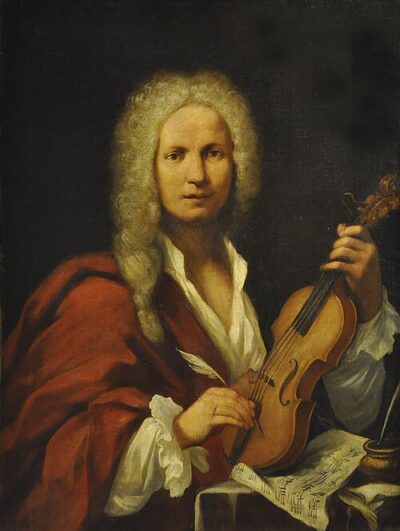
Antonio Vivaldi
Antonio Vivaldi was an Italian composer and violinist. Born March 4, 1678, in Venice. Died July 28, 1741, in Vienna. Positions held include chapelmaster (1718–1720), music teacher (1703–) and Latin Catholic priest (1703–). Known for The Four Seasons, Orlando furioso and Juditha triumphans.
Facts
41 facts · 2 confirmed by two sources · 23 cited · 16 from one source
Where this comes from
Papalocal keeps its own record. It started from these sources; what each one said is kept here as it was copied, so a change on their side never changes this page by itself. Tap one to read its version.
What Wikidata says · copied November 16, 2026 · revision 2568006840
- Described as
- Italian composer and violinist (1678–1741)
- Other names
- A. Vivaldis, Antonio Vivarudi, Antonio Luciano Vivaldi, Antonio Lucio Vivaldi, Vivaldi, Prete rosso
- Born
- March 4, 1678 · 14 references
- Died
- July 28, 1741 · 13 references
- Born in
- Venice · 4 references
- Died in
- Vienna · 4 references
- Buried in
- Bürgerspital-Gottesacker
- Name at birth
- Antonio Lucio Vivaldi
- Citizen of
- Republic of Venice
- Occupation
- opera composer; Latin Catholic priest · 1 reference; composer · 3 references; musician · 1 reference; violinist · 1 reference; chapelmaster · 1 reference; music educator · 1 reference; theatre manager · 1 reference
- Positions held
- chapelmaster (1718–1720); music teacher (1703–) · 1 reference; Latin Catholic priest (1703–) · 1 reference
- Worked for
- Ospedale della Pietà · 1 reference; Philip of Hesse-Darmstadt · 1 reference; Teatro San Angelo · 1 reference
- Genre
- opera; chamber music; church music; concerto; sinfonia; sardana · 1 reference
- Instrument
- violin · 1 reference; harpsichord; viola d'amore · 1 reference
- Known for
- The Four Seasons · 1 reference; Orlando furioso; Juditha triumphans · 1 reference; Manchester Sonatas · 1 reference; L'estro armonico, Op. 3 · 1 reference; Gloria in D Major · 1 reference; Stabat Mater; Giustino
- Father
- Giovanni Battista Vivaldi · 1 reference
- Mother
- Camilla Calicchio
- Religion
- Roman Catholic
- Wikipedias with a page
- 169
Wikidata item Q1340 (wikidata.org/wiki/Q1340), public domain (CC0). Copied November 16, 2026.
What Wikipedia says · copied November 16, 2026 · revision 1385543293
Antonio Lucio Vivaldi (4 March 1678 – 28 July 1741) was an Italian composer, virtuoso violinist, and impresario of Baroque music. Regarded as one of the greatest Baroque composers, Vivaldi was influential across Europe during his lifetime, giving origin to many imitators and admirers. He pioneered many developments in orchestration, violin technique and programmatic music. He consolidated the emerging concerto form, especially the solo concerto, into a widely accepted and followed idiom.
Vivaldi composed many instrumental concertos, for the violin and a variety of other musical instruments, as well as sacred choral works and more than fifty operas. His best-known work is a series of violin concertos known as The Four Seasons. Many of his compositions were written for the all-female music ensemble of the Ospedale della Pietà, a home for abandoned children in his native Venice.
Vivaldi began studying for the Catholic priesthood at the age of 15 and was ordained at 25, but was given dispensation to no longer say public Masses because of a health problem. Vivaldi also had some success with expensive stagings of his operas in Venice, Mantua, and Vienna. After meeting the Emperor Charles VI, he moved to Vienna, hoping for royal support, but the emperor died soon after his arrival, and Vivaldi died in poverty less than a year later.
After almost two centuries of decline, Vivaldi's musical reputation underwent a revival in the early 20th century, with much scholarly research devoted to his work. Many of his compositions, once thought lost, have been rediscovered – some as recently as 2015. His music remains widely popular in the present day and is regularly played all over the world.
- Born, in its opening lines
- March 4, 1678
- Died, in its opening lines
- July 28, 1741
From the Wikipedia article “Antonio Vivaldi” (en.wikipedia.org/wiki/Antonio_Vivaldi), by its contributors, under CC BY-SA 4.0 (creativecommons.org/licenses/by-sa/4.0/). Copied November 16, 2026; not changed.
Confirmed Two sources agree. Cited One source, and it names where it got it. One source One source, without a reference of its own. Sources disagree The sources disagree. We show the best-supported value and keep theirs below.
