
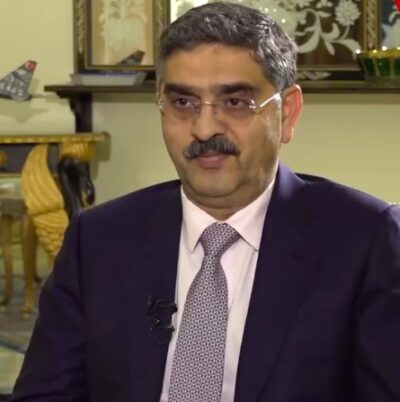
Anwar ul Haq Kakar
Anwar ul Haq Kakar is a Caretaker Prime Minister of Pakistan. Born May 15, 1971, in Balochistan. Positions held include Senator (2018–2023) and Caretaker Prime Minister of Pakistan (2023–2024).
Facts
7 facts · 1 confirmed by two sources · 1 cited · 5 from one source
Where this comes from
Papalocal keeps its own record. It started from these sources; what each one said is kept here as it was copied, so a change on their side never changes this page by itself. Tap one to read its version.
What Wikidata says · copied November 18, 2026 · revision 2565512263
- Described as
- Caretaker Prime Minister of Pakistan (born 1971)
- Born
- May 15, 1971
- Born in
- Balochistan · 1 reference
- Citizen of
- Pakistan
- Occupation
- politician
- Positions held
- Senator (2018–2023) · 1 reference; Caretaker Prime Minister of Pakistan (2023–2024)
- Political party
- Balochistan Awami Party (2018–2023) · 1 reference
- Wikipedias with a page
- 24
Wikidata item Q50345548 (wikidata.org/wiki/Q50345548), public domain (CC0). Copied November 18, 2026.
What Wikipedia says · copied November 18, 2026 · revision 1385095049
Anwaar ul-Haq Kakar (born 15 May 1971) is a Pakistani politician who served as the longest-serving caretaker prime minister of Pakistan between 14 August 2023 and 4 March 2024. He was succeeded by his predecessor Shehbaz Sharif. He assumed membership in the Upper House of Pakistan in March 2018. Before taking on the role of caretaker prime minister, Kakar had resigned from the upper house of parliament. Subsequently, he publicly declared his resignation from both the Senate and the Balochistan Awami Party (BAP), a political party he established in 2018.
Kakar also served as the spokesperson of the Government of Balochistan from 2015 to 2017.
- Born, in its opening lines
- May 15, 1971
From the Wikipedia article “Anwaar ul Haq Kakar” (en.wikipedia.org/wiki/Anwaar_ul_Haq_Kakar), by its contributors, under CC BY-SA 4.0 (creativecommons.org/licenses/by-sa/4.0/). Copied November 18, 2026; not changed.
Confirmed Two sources agree. Cited One source, and it names where it got it. One source One source, without a reference of its own. Sources disagree The sources disagree. We show the best-supported value and keep theirs below.
