
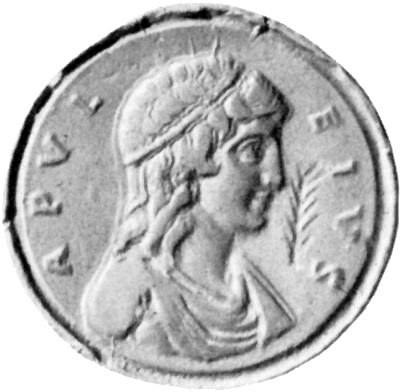
Apuleius
Apuleius was the 2nd-century Numidian Latin-language writer, rhetorician and philosopher. Born 125, in Madauros. Died 170, in Roman Carthage. Known for The Golden Ass and Apologia.
Facts
19 facts · 0 confirmed by two sources · 11 cited · 7 from one source · 1 where the sources disagree
What’s different
- Born: we show 125 (Sources disagree). Wikidata also lists 2nd century
Where this comes from
Papalocal keeps its own record. It started from these sources; what each one said is kept here as it was copied, so a change on their side never changes this page by itself. Tap one to read its version.
What Wikidata says · copied November 16, 2026 · revision 2567806338
- Described as
- 2nd-century Numidian Latin-language writer, rhetorician and philosopher
- Other names
- Lucius Apuleius
- Born
- 125 · 4 references; 2nd century · 1 reference
- Died
- 170 · 1 reference
- Born in
- Madauros · 1 reference
- Died in
- Roman Carthage
- Citizen of
- Ancient Rome
- Occupation
- writer · 4 references; philosopher · 1 reference; novelist; poet · 1 reference; rhetorician · 2 references; physician · 1 reference; prose writer; lawyer · 2 references
- Known for
- The Golden Ass; Apologia
- Field
- philosophy; legal work · 1 reference; rhetoric · 1 reference; creative and professional writing · 1 reference
- Wikipedias with a page
- 102
Wikidata item Q170512 (wikidata.org/wiki/Q170512), public domain (CC0). Copied November 16, 2026.
What Wikipedia says · copied November 16, 2026 · revision 1385556155
Apuleius ( APP-yuu-LEE-əs), also called Lucius Apuleius Madaurensis (c. 124 – after 170), was a Numidian Latin-language prose writer, Platonist philosopher and rhetorician. He was born in the Roman province of Numidia, in the Berber city of Madauros, modern-day M'Daourouch, Algeria. He studied Platonism in Athens, travelled to Italy, Asia Minor, and Egypt, and was an initiate in several cults or mysteries. The most famous incident in his life was when he was accused of using magic to gain the attentions (and fortune) of a wealthy widow. He declaimed his own defense before the proconsul and a court of magistrates convened in Sabratha, near Oea (modern Tripoli, Libya). This speech, which Apuleius subsequently published, is known as the Apologia.
His most famous work is his bawdy picaresque novel the Metamorphoses, otherwise known as The Golden Ass. It is the only ancient Latin novel that has survived in its entirety. It relates the adventures of its protagonist, Lucius, who experiments with magic and is accidentally turned into a donkey. Lucius goes through various adventures before he is turned back into a human being by the goddess Isis.
From the Wikipedia article “Apuleius” (en.wikipedia.org/wiki/Apuleius), by its contributors, under CC BY-SA 4.0 (creativecommons.org/licenses/by-sa/4.0/). Copied November 16, 2026; not changed.
Confirmed Two sources agree. Cited One source, and it names where it got it. One source One source, without a reference of its own. Sources disagree The sources disagree. We show the best-supported value and keep theirs below.
