
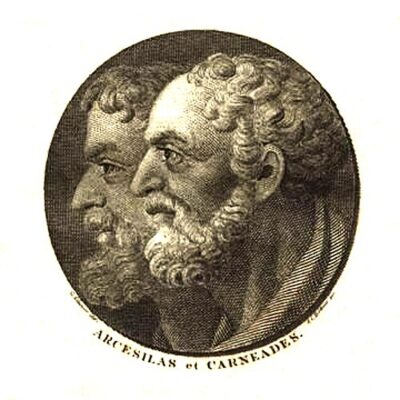
Arcesilaus
Arcesilaus was the 3rd-century BC Greek Hellenistic philosopher. Born 315 BC, in Pitane. Died 240 BC, in Classical Athens. Positions held include scholarch of the Platonic Academy (–-241).
Facts
9 facts · 0 confirmed by two sources · 0 cited · 9 from one source
Where this comes from
Papalocal keeps its own record. It started from these sources; what each one said is kept here as it was copied, so a change on their side never changes this page by itself. Tap one to read its version.
What Wikidata says · copied November 16, 2026 · revision 2569014418
- Described as
- 3rd-century BC Greek Hellenistic philosopher
- Other names
- Arcesilaus of Pitane
- Born
- 315 BC
- Died
- 240 BC
- Born in
- Pitane · 1 reference
- Died in
- Classical Athens
- Citizen of
- Classical Athens
- Occupation
- philosopher
- Positions held
- scholarch of the Platonic Academy (–-241)
- Field
- philosophy
- Lived in
- Classical Athens
- Wikipedias with a page
- 45
Wikidata item Q73527 (wikidata.org/wiki/Q73527), public domain (CC0). Copied November 16, 2026.
What Wikipedia says · copied November 16, 2026 · revision 1355545845
Arcesilaus (; Ancient Greek: Ἀρκεσίλαος; 316/5–241/0 BC) was a Greek Hellenistic philosopher. He was the founder of Academic Skepticism and what is variously called the Second or Middle or New Academy – the phase of the Platonic Academy in which it embraced philosophical skepticism.
Arcesilaus succeeded Crates of Athens as the sixth scholarch of the academy around 264 BC. He did not preserve his thoughts in writing, so his opinions can only be gleaned second-hand from what is preserved by later writers.
In Athens Arcesilaus interacted with the Pyrrhonist philosopher, Timon of Phlius, whose philosophy appears to have influenced Arcesilaus to become the first Academic to adopt a position of philosophical skepticism, that is, he doubted the ability of the senses to discover truth about the world, although he may have continued to believe in the existence of truth itself. This brought in the skeptical phase of the academy. His chief opponent was his contemporary, Zeno of Citium, the founder of Stoicism, whose dogma of katalepsis (i.e., that reality could be comprehended with certainty) Arcesilaus denied.
From the Wikipedia article “Arcesilaus” (en.wikipedia.org/wiki/Arcesilaus), by its contributors, under CC BY-SA 4.0 (creativecommons.org/licenses/by-sa/4.0/). Copied November 16, 2026; not changed.
Confirmed Two sources agree. Cited One source, and it names where it got it. One source One source, without a reference of its own. Sources disagree The sources disagree. We show the best-supported value and keep theirs below.
