
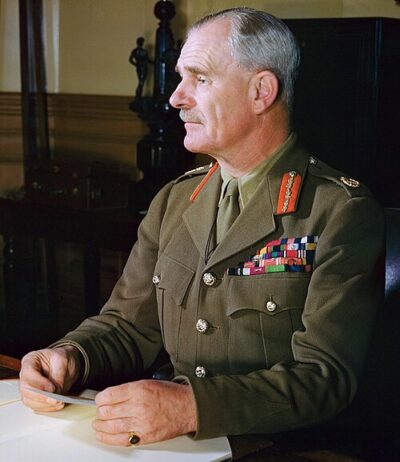
Archibald Wavell, 1st Earl Wavell
Archibald Wavell, 1st Earl Wavell was a British Army general and Viceroy of India. Born May 5, 1883, in Colchester. Died May 24, 1950, in London. Positions held include Governor-General of India (1943–1947), member of the House of Lords and Member of the Privy Council of the United Kingdom. Educated at Winchester College and Royal Military College, Sandhurst. Awards include Commander of the Legion of Honour, Military Cross and Knight Grand Cross of the Order of the Bath.
Facts
48 facts · 2 confirmed by two sources · 9 cited · 37 from one source
Where this comes from
Papalocal keeps its own record. It started from these sources; what each one said is kept here as it was copied, so a change on their side never changes this page by itself. Tap one to read its version.
What Wikidata says · copied November 16, 2026 · revision 2533473476
- Described as
- British Army general and Viceroy of India
- Other names
- Archibald Percival Wavell
- Born
- May 5, 1883 · 8 references
- Died
- May 24, 1950 · 8 references
- Born in
- Colchester
- Died in
- London
- Buried in
- Beaulieu Abbey
- Citizen of
- United Kingdom
- Occupation
- politician · 1 reference; military officer; army officer; soldier · 1 reference; Generalfeldmarschall · 1 reference
- Positions held
- Governor-General of India (1943–1947); member of the House of Lords; Member of the Privy Council of the United Kingdom; Constable of the Tower (1948–1950); Lord Lieutenant of the County of London (1949–1950)
- Education
- Winchester College; Royal Military College, Sandhurst; Summer Fields School; Staff College, Camberley; Command and Staff College
- Awards
- Commander of the Legion of Honour; Military Cross; Knight Grand Cross of the Order of the Bath; Chief Commander of the Legion of Merit; Companion of the Order of St Michael and St George; Legionnaire of Legion of Merit; Order of Saint Stanislaus, 3rd class with swords; Order of the Star of Nepal; Order of the Star of India · 1 reference; Order of Saint John · 1 reference; Order of the Indian Empire · 1 reference; 1939–45 Star · 1 reference; Africa Star · 1 reference; Legion of Merit · 1 reference; King George V Silver Jubilee Medal · 1 reference
- Spouse
- Eugenie Marie Quirk (1915–) · 1 reference
- Children
- Archibald Wavell, 2nd Earl Wavell · 1 reference; Lady Eugenie Pamela Wavell · 1 reference; Lady Felicity Ann Wavell · 1 reference; Lady Joan Patricia Quirk Wavell · 1 reference
- Father
- Archibald Graham Wavell · 1 reference
- Mother
- Lillie Percival · 1 reference
- Religion
- Anglicanism
- Military branch
- British Army
- Military rank
- field marshal; general; general (1939–)
- Wikipedias with a page
- 50
Wikidata item Q315540 (wikidata.org/wiki/Q315540), public domain (CC0). Copied November 16, 2026.
What Wikipedia says · copied November 16, 2026 · revision 1385575322
Field Marshal Archibald Percival Wavell, 1st Earl Wavell (5 May 1883 – 24 May 1950) was a senior officer of the British Army. He served in the Second Boer War, the Bazar Valley Campaign and the First World War, during which he was wounded in the Second Battle of Ypres. In the Second World War, he served initially as Commander-in-Chief Middle East, in which role he led British forces to victory over the Italian Army in Eritrea-Abyssinia, western Egypt and eastern Libya during Operation Compass in December 1940, only to be defeated by Erwin Rommel's Panzer Army Africa in the Western Desert in April 1941. He served as Commander-in-Chief, India, from July 1941 until June 1943 (apart from a brief tour as Commander of American-British-Dutch-Australian Command) and then served as Viceroy of India until his retirement in February 1947.
- Born, in its opening lines
- May 5, 1883
- Died, in its opening lines
- May 24, 1950
From the Wikipedia article “Archibald Wavell, 1st Earl Wavell” (en.wikipedia.org/wiki/Archibald_Wavell,_1st_Earl_Wavell), by its contributors, under CC BY-SA 4.0 (creativecommons.org/licenses/by-sa/4.0/). Copied November 16, 2026; not changed.
Confirmed Two sources agree. Cited One source, and it names where it got it. One source One source, without a reference of its own. Sources disagree The sources disagree. We show the best-supported value and keep theirs below.
