
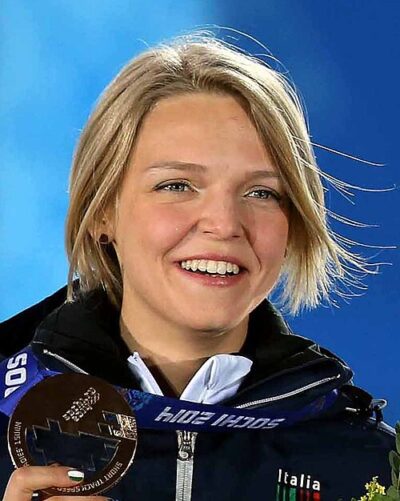
Arianna Fontana is an Italian short track speed skater. Born April 14, 1990, in Sondrio. Awards include Knight of the Order of Merit of the Italian Republic.
Facts
8 facts · 1 confirmed by two sources · 2 cited · 5 from one source
Where this comes from
Papalocal keeps its own record. It started from these sources; what each one said is kept here as it was copied, so a change on their side never changes this page by itself. Tap one to read its version.
What Wikidata says · copied November 16, 2026 · revision 2516814499
- Described as
- Italian short track speed skater
- Born
- April 14, 1990
- Born in
- Sondrio
- Citizen of
- Italy
- Occupation
- short-track speed skater
- Sport
- speed skating
- Awards
- Knight of the Order of Merit of the Italian Republic (2006) · 1 reference
- Spouse
- Anthony Lobello Jr.
- Height
- 1.64 m (5 ft 5 in) · 1 reference
- Wikipedias with a page
- 32
Wikidata item Q259815 (wikidata.org/wiki/Q259815), public domain (CC0). Copied November 16, 2026.
What Wikipedia says · copied November 16, 2026 · revision 1383815476
Arianna Fontana OMRI (born 14 April 1990) is an Italian short track speed skater and the first woman to win Olympic medals in six straight Winter Olympics. Specializing in the 500 m event, among her fourteen Olympic medals are two gold medals in the 500 m short track, one at the 2018 Winter Olympics in Pyeongchang and the second one at the 2022 Winter Olympics in Beijing, as well as a gold medal at the 2026 Winter Olympics 2000 m mixed relay in her home country of Italy. She is the short track skater with the most Olympic medals, and the Italian athlete, including both men and women, with the highest number of medals 14, in both the Summer and Winter Olympic Games, and the Italian sportswoman with the highest number of Winter Olympic medals, three more than Stefania Belmondo.
- Born, in its opening lines
- April 14, 1990
From the Wikipedia article “Arianna Fontana” (en.wikipedia.org/wiki/Arianna_Fontana), by its contributors, under CC BY-SA 4.0 (creativecommons.org/licenses/by-sa/4.0/). Copied November 16, 2026; not changed.
Confirmed Two sources agree. Cited One source, and it names where it got it. One source One source, without a reference of its own. Sources disagree The sources disagree. We show the best-supported value and keep theirs below.
