
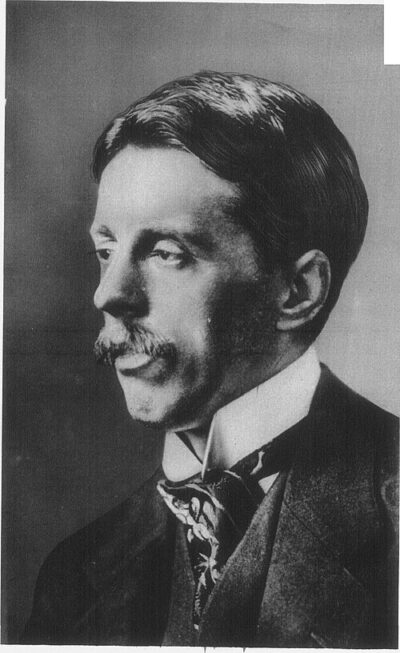
Arnold Bennett
Arnold Bennett was an English writer. Born May 27, 1867, in Hanley. Died March 27, 1931, in City of Westminster. Known for Those United States. Educated at Wedgwood Institute. Awards include James Tait Black Memorial Prize.
Facts
24 facts · 2 confirmed by two sources · 9 cited · 12 from one source · 1 where the sources disagree
What’s different
- Born in: we show Hanley (Sources disagree). Wikidata also lists Burslem
Where this comes from
Papalocal keeps its own record. It started from these sources; what each one said is kept here as it was copied, so a change on their side never changes this page by itself. Tap one to read its version.
What Wikidata says · copied November 16, 2026 · revision 2568731101
- Described as
- English writer (1867–1931)
- Other names
- Enoch Arnold Bennett
- Born
- May 27, 1867 · 15 references
- Died
- March 27, 1931 · 14 references
- Born in
- Hanley · 2 references; Burslem · 1 reference
- Died in
- City of Westminster
- Buried in
- Staffordshire
- Cause of death
- typhoid fever · 1 reference
- Name at birth
- Enoch Arnold Bennett · 1 reference
- Citizen of
- United Kingdom
- Occupation
- screenwriter · 2 references; novelist; autobiographer; diarist; writer · 4 references; journalist · 1 reference; playwright; literary critic
- Education
- Wedgwood Institute · 1 reference
- Known for
- Those United States
- Awards
- James Tait Black Memorial Prize (1923)
- Field
- literature · 1 reference; theatre · 1 reference; journalism · 1 reference
- Spouse
- Marguerite Bennett · 1 reference
- Website
- http://www.arnoldbennettsociety.org.uk/
- Wikipedias with a page
- 55
Wikidata item Q314158 (wikidata.org/wiki/Q314158), public domain (CC0). Copied November 16, 2026.
What Wikipedia says · copied November 16, 2026 · revision 1385177873
Enoch Arnold Bennett (27 May 1867 – 27 March 1931) was an English author, best known as a novelist, who wrote prolifically. Between the 1890s and the 1930s he completed 34 novels, seven volumes of short stories, 13 plays (some in collaboration with other writers), and a daily journal totalling more than a million words. He wrote articles and stories for more than 100 newspapers and periodicals, worked in and briefly ran the Ministry of Information during the First World War, and wrote for the cinema in the 1920s. Sales of his books were substantial, and he was the most financially successful British author of his day.
Born into a modest but upwardly mobile family in Hanley, in the Staffordshire Potteries, Bennett was intended by his father, a solicitor, to follow him into the legal profession. Bennett worked for his father before moving to another law firm in London as a clerk at the age of 21. He became assistant editor and then editor of a women's magazine before becoming a full-time author in 1900. Always a devotee of French culture in general and French literature in particular, he moved to Paris in 1903; there the relaxed milieu helped him overcome his intense shyness, particularly with women. He spent ten years in France, marrying a Frenchwoman in 1907. In 1912 he moved back to England. He and his wife separated in 1921, and he spent the last years of his life with a new partner, an English actress. He died in 1931 of typhoid fever, having drunk contaminated tap water in France.
Many of Bennett's novels and short stories are set in a fictionalised version of the Staffordshire Potteries, which he called The Five Towns. He strongly believed that literature should be accessible to ordinary people, and he deplored literary cliques and élites. His books appealed to a wide public and sold in large numbers. For this reason, and for his adherence to realism, writers and supporters of the modernist school, notably Virginia Woolf, belittled him, and his fiction became neglected after his death. During his lifetime his journalistic "self-help" books sold in substantial numbers, and he was also a playwright. He did less well in the theatre than with novels but achieved two considerable successes with Milestones (1912) and The Great Adventure (1913).
Studies by Margaret Drabble (1974), John Carey (1992), and others have led to a re-evaluation of Bennett's work. Anna of the Five Towns (1902), The Old Wives' Tale (1908), Clayhanger (1910) and Riceyman Steps (1923) are considered the finest of his novels, and are now widely recognised as major works.
- Born, in its opening lines
- May 27, 1867
- Died, in its opening lines
- March 27, 1931
From the Wikipedia article “Arnold Bennett” (en.wikipedia.org/wiki/Arnold_Bennett), by its contributors, under CC BY-SA 4.0 (creativecommons.org/licenses/by-sa/4.0/). Copied November 16, 2026; not changed.
Confirmed Two sources agree. Cited One source, and it names where it got it. One source One source, without a reference of its own. Sources disagree The sources disagree. We show the best-supported value and keep theirs below.
