
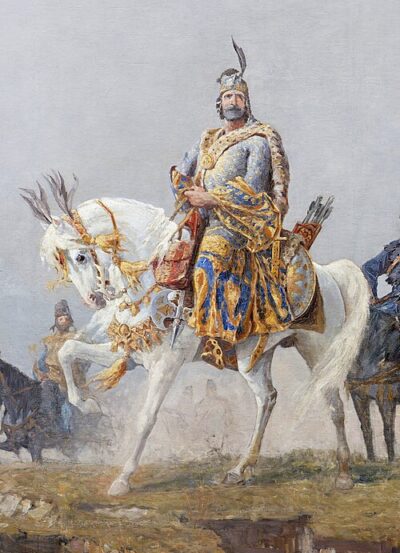
Árpád
Árpád was a Grand Prince of the Hungarians. Born 845. Died 907. Positions held include Grand Prince of the Hungarians (895–907).
Facts
13 facts · 0 confirmed by two sources · 0 cited · 13 from one source
Where this comes from
Papalocal keeps its own record. It started from these sources; what each one said is kept here as it was copied, so a change on their side never changes this page by itself. Tap one to read its version.
What Wikidata says · copied November 16, 2026 · revision 2538670725
- Described as
- Grand Prince of the Hungarians
- Other names
- Árpád Árpád, Árpád of Hungary, Grand Prince Árpád, Arpad
- Born
- 845
- Died
- 907
- Citizen of
- Principality of Hungary; Khazar Khaganate
- Occupation
- traditional leader or chief
- Positions held
- Grand Prince of the Hungarians (895–907)
- Children
- Zoltán of Hungary; Jelek; Liüntika; Tarhacsi; Jutas
- Father
- Álmos, Grand Prince of the Magyars
- Religion
- Hungarian mythology
- Wikipedias with a page
- 53
Wikidata item Q210207 (wikidata.org/wiki/Q210207), public domain (CC0). Copied November 16, 2026.
What Wikipedia says · copied November 16, 2026 · revision 1360111753
Árpád (Hungarian pronunciation: [ˈaːrpaːd]; c. 845 – c. 907) was the head of the confederation of the Magyar tribes at the turn of the 9th and 10th centuries. He might have been either the sacred ruler or kende of the Hungarians, or their military leader or gyula, although most details of his life are debated by historians, because different sources contain contradictory information. Despite this, many Hungarians refer to him as the "founder of our country", and Árpád's preeminent role in the Hungarian conquest of the Carpathian Basin has been emphasized by some later chronicles. The dynasty descending from Árpád ruled the Kingdom of Hungary until 1301.
From the Wikipedia article “Árpád” (en.wikipedia.org/wiki/Árpád), by its contributors, under CC BY-SA 4.0 (creativecommons.org/licenses/by-sa/4.0/). Copied November 16, 2026; not changed.
Confirmed Two sources agree. Cited One source, and it names where it got it. One source One source, without a reference of its own. Sources disagree The sources disagree. We show the best-supported value and keep theirs below.
