
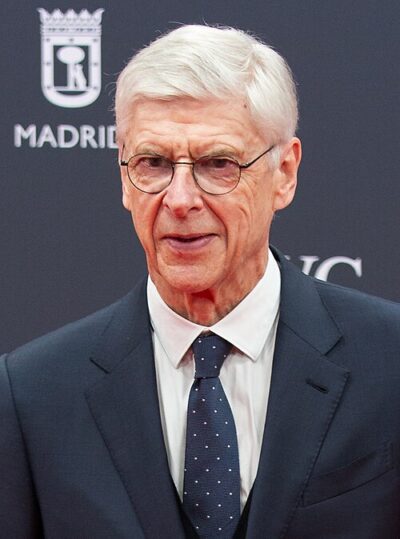
Arsène Wenger
Arsène Wenger is a French football manager. Born October 22, 1949, in Strasbourg. Teams include FC Mulhouse (1973–1975), RC Strasbourg Alsace (1978–1981) and AS Mutzig (1969–1973). Educated at University of Strasbourg and University of Strasbourg. Awards include Knight of the Legion of Honour, Honorary Officer of the Order of the British Empire and Officer of the Legion of Honour.








Facts
20 facts · 1 confirmed by two sources · 3 cited · 16 from one source
Where this comes from
Papalocal keeps its own record. It started from these sources; what each one said is kept here as it was copied, so a change on their side never changes this page by itself. Tap one to read its version.
What Wikidata says · copied November 16, 2026 · revision 2568219335
- Described as
- French football manager (born 1949)
- Other names
- Arsene Wenger, Arsène Charles Ernest Wenger, Arsene Charles Ernest Wenger
- Born
- October 22, 1949 · 3 references
- Born in
- Strasbourg · 2 references
- Name at birth
- Arsène Charles Ernest Wenger · 1 reference
- Citizen of
- France
- Occupation
- association football player · 1 reference; economist; association football coach · 1 reference; engineer
- Education
- University of Strasbourg; University of Strasbourg
- Teams
- FC Mulhouse (1973–1975); RC Strasbourg Alsace (1978–1981); AS Mutzig (1969–1973); ASPV Strasbourg (1975–1978)
- Sport
- association football
- Awards
- Knight of the Legion of Honour (2002) · 1 reference; Honorary Officer of the Order of the British Empire; Officer of the Legion of Honour (2019) · 1 reference
- Field
- association football · 1 reference
- Height
- 1.93 m (6 ft 4 in)
- Wikipedias with a page
- 93
Wikidata item Q47576 (wikidata.org/wiki/Q47576), public domain (CC0). Copied November 16, 2026.
What Wikipedia says · copied November 16, 2026 · revision 1384994388
Arsène Charles Ernest Wenger (born 22 October 1949) is a French former football manager and player who has been serving as FIFA's Chief of Global Football Development since 2019. Nicknamed Le Professeur, he is widely regarded as one of the most influential football managers of his generation. Wenger was the manager of Arsenal from 1996 to 2018, becoming the longest-serving and most successful manager in the club's history and the longest-serving manager in the history of the Premier League.
Born in Strasbourg and raised in Duttlenheim, Wenger was introduced to football by his father, the manager of the local village team. After a modest playing career as a midfielder, with appearances for clubs including FC Mulhouse and RC Strasbourg, he obtained a manager's diploma in 1981. Wenger began his managerial career at Nancy in 1984 before joining Monaco in 1987. At Monaco, he won the French league title and the Coupe de France in 1991. In 1995, Wenger moved to Japan to manage Nagoya Grampus Eight, where he won both the Emperor's Cup and the Japanese Super Cup.
In 1996, Wenger was appointed manager of Arsenal. Initially greeted with scepticism by the English media, he went on to transform the club and English football through innovations in nutrition, training methods, and global scouting. He became the first foreign manager to win a Premier League and FA Cup double in 1998, repeated the feat in 2002, and led Arsenal to an unbeaten league title in 2004. His team later set an English record of 49 consecutive league matches unbeaten. Under Wenger, Arsenal reached their first UEFA Champions League final in 2006 and relocated from Highbury to the Emirates Stadium. Financial constraints following the move contributed to a nine-year trophy drought, though Wenger later guided the club to further FA Cup victories in the 2010s, becoming the competition's most successful manager with seven wins. He stepped down as Arsenal manager in 2018 and retired from club management.
Wenger is credited with reshaping English football culture and modernising the managerial profession, though his teams were occasionally criticised for tactical naivety and disciplinary issues. Wenger is also noted for his emphasis on youth development and talent identification throughout his career.
- Born, in its opening lines
- October 22, 1949
From the Wikipedia article “Arsène Wenger” (en.wikipedia.org/wiki/Arsène_Wenger), by its contributors, under CC BY-SA 4.0 (creativecommons.org/licenses/by-sa/4.0/). Copied November 16, 2026; not changed.
Confirmed Two sources agree. Cited One source, and it names where it got it. One source One source, without a reference of its own. Sources disagree The sources disagree. We show the best-supported value and keep theirs below.
