
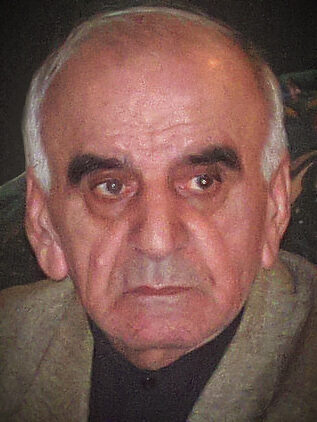
Artavazd Peleshyan
Artavazd Peleshyan is an Armenian film director. Born February 22, 1938, in Gyumri. Educated at Gerasimov Institute of Cinematography. Awards include Honored art worker of the Russian Federation, Honored Art Worker of the Armenian SSR and Order of St. Mesrop Mashtots.
Facts
21 facts · 1 confirmed by two sources · 1 cited · 19 from one source
Where this comes from
Papalocal keeps its own record. It started from these sources; what each one said is kept here as it was copied, so a change on their side never changes this page by itself. Tap one to read its version.
What Wikidata says · copied November 18, 2026 · revision 2567247996
- Described as
- Armenian film director
- Born
- February 22, 1938
- Born in
- Gyumri · 1 reference
- Citizen of
- Soviet Union; Armenia; Russia
- Occupation
- film director; screenwriter; actor
- Worked for
- Top Courses for Scriptwriters and Film Directors
- Education
- Gerasimov Institute of Cinematography (1963–1967)
- Member of
- Union of Cinematographers of the Russian Federation; LaScam (1991–)
- Awards
- Honored art worker of the Russian Federation (1996); Honored Art Worker of the Armenian SSR (1979); Order of St. Mesrop Mashtots (1996); Order of the Badge of Honour (2018); honorary citizen of Yerevan (2017); médaille du Premier ministre (2012); Armenian SSR State Prize (1985); Order of St. Sergius of Radonezh (1984); Laurel Branch Award (2003)
- Wikipedias with a page
- 20
Wikidata item Q706217 (wikidata.org/wiki/Q706217), public domain (CC0). Copied November 18, 2026.
What Wikipedia says · copied November 18, 2026 · revision 1372557984
Artavazd Peleshyan (Armenian: Արտավազդ (Արթուր) Փելեշյան, romanized: Artavazd (Art’ur) P’eleshyan; also Pelechian, Peleshian; born February 22, 1938) is an Armenian director of essay films, a documentarian in the history of film art, a screenwriter, and a film theorist. He is renowned for developing a style of cinematographic perspective known as distance montage, combining perception of depth with oncoming entities, such as running packs of antelope or hordes of humans. Filmmaker Sergei Parajanov has referred to Peleshyan as "one of the few authentic geniuses in the world of cinema". Peleshyan was awarded the title of Merited Artist of the Armenian SSR in 1979, and Merited Artist of the Russian Federation in 1995.
His films have been described as being on the border between a documentary and a feature film, somewhat reminiscent of the work of such avant-garde filmmakers as Bruce Conner, rather than of conventional documentaries. However, it has been noted that his work, unlike Maya Deren's, is not firmly within the avant-garde, and that it does not try to explore the absurd. Peleshyan's films have been summarized as "a poetic view of life transferred onto film."
He has made extensive use of archive footage and for the first time used only original footage in his most celebrated film, Seasons of the Year, shot by cinematographer Mikhail Vartanov. Telephoto lenses are often used to get "candid camera" shots of people engaging in mundane tasks.
Most of Peleshyan's films are short, ranging from 6 to about 60 minutes long, and feature no dialogue. However, music and sound effects play nearly as important a role in his films as the visual images in contributing towards the artistic whole. Nearly all of his films were shot in black-and-white.
In 2020, the Fondation Cartier pour l’art contemporain presented Artavazd Peleshyan: La Nature, a major exhibition that premiered his first new film in over twenty-five years, Nature, and highlighted his enduring influence on documentary and experimental cinema.
- Born, in its opening lines
- February 22, 1938
From the Wikipedia article “Artavazd Peleshyan” (en.wikipedia.org/wiki/Artavazd_Peleshyan), by its contributors, under CC BY-SA 4.0 (creativecommons.org/licenses/by-sa/4.0/). Copied November 18, 2026; not changed.
Confirmed Two sources agree. Cited One source, and it names where it got it. One source One source, without a reference of its own. Sources disagree The sources disagree. We show the best-supported value and keep theirs below.
