
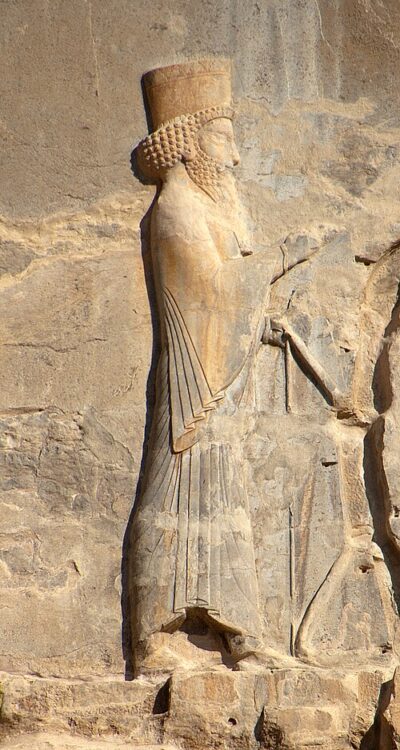
Artaxerxes II
Artaxerxes II was The 10th Achaemenid Emperor. Born 453 BC. Died February 358 BC, in Persepolis. Positions held include pharaoh and King of Kings.
Facts
26 facts · 0 confirmed by two sources · 2 cited · 22 from one source · 2 where the sources disagree
What’s different
- Born: we show 453 BC (Sources disagree). Wikidata also lists 452 BC
- Died: we show February 358 BC (Sources disagree). Wikidata also lists March 1, 358 BC
Where this comes from
Papalocal keeps its own record. It started from these sources; what each one said is kept here as it was copied, so a change on their side never changes this page by itself. Tap one to read its version.
What Wikidata says · copied November 16, 2026 · revision 2566533257
- Described as
- The 10th Achaemenid Emperor (404–358 BC)
- Other names
- Artaxerxes II Mnemon
- Born
- 453 BC · 1 reference; 452 BC · 1 reference
- Died
- February 358 BC · 1 reference; March 1, 358 BC · 1 reference
- Died in
- Persepolis · 1 reference
- Buried in
- Persepolis
- Citizen of
- Achaemenid Empire
- Occupation
- king
- Positions held
- pharaoh; King of Kings · 1 reference
- Spouse
- Stateira; Aspasia the Younger; Amestris; Atossa
- Children
- Artaxerxes III · 1 reference; Rhodogune; Atossa · 1 reference; Arsames; Apama; Amestris · 1 reference; Darius; Ariaspes
- Father
- Darius II · 2 references
- Mother
- Parysatis · 2 references
- Siblings
- Ostanes; Cyrus the Younger · 1 reference; Amestris
- Religion
- Mazdaism
- Wikipedias with a page
- 58
Wikidata item Q188472 (wikidata.org/wiki/Q188472), public domain (CC0). Copied November 16, 2026.
What Wikipedia says · copied November 16, 2026 · revision 1382196669
Arses or Arsaces (c. 445–359/8 BC), known by his regnal name Artaxerxes II (Old Persian: 𐎠𐎼𐎫𐎧𐏁𐏂 Artaxšaçāʰ; Ancient Greek: Ἀρταξέρξης), was King of Kings of the Achaemenid Empire from 405/4 BC to 359/8 BC. He was the son and successor of Darius II (r. 423 – 405/4 BC) and his mother was Parysatis.
Soon after his accession, Artaxerxes II faced opposition from his younger brother Cyrus the Younger, who assembled an army composed of troops from his Lydian and Ionian satrapies as well as Greek mercenaries in his bid for the throne. The forces of the brothers clashed at Cunaxa in 401 BC, which resulted in the defeat and death of Cyrus. Following this, Artaxerxes II had to contend with several other revolts; a revolt by Evagoras I (r. 411–374 BC) in Cyprus between 391–380 BC, by the Phoenicians in c. 380 BC, and most importantly, the revolts by the western satraps (known as the Great Satraps' Revolt) in the 360s and 350s BC, led by distinguished figures such as Datames, Ariobarzanes, and Autophradates.
The rulers of the Parthian Empire notably considered Artaxerxes II their progenitor.
- Born, in its opening lines
- 445
- Died, in its opening lines
- 359
From the Wikipedia article “Artaxerxes II” (en.wikipedia.org/wiki/Artaxerxes_II), by its contributors, under CC BY-SA 4.0 (creativecommons.org/licenses/by-sa/4.0/). Copied November 16, 2026; not changed.
Confirmed Two sources agree. Cited One source, and it names where it got it. One source One source, without a reference of its own. Sources disagree The sources disagree. We show the best-supported value and keep theirs below.
