
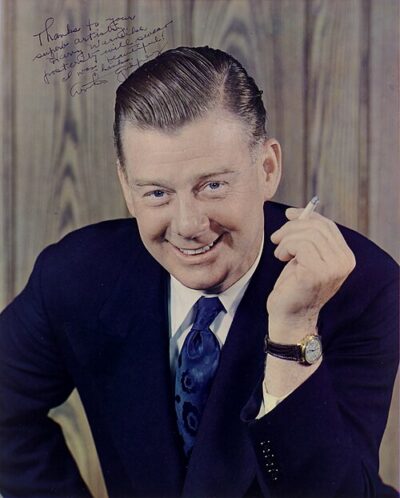
Arthur Godfrey
Arthur Godfrey was an American radio personality and television actor. Born August 31, 1903, in Manhattan. Died March 16, 1983, in Manhattan. Educated at Radio Materiel School and Hasbrouck Heights High School. Awards include Peabody Awards, National Aviation Hall of Fame and Aviation Hall of Fame and Museum of New Jersey.
Facts
25 facts · 2 confirmed by two sources · 3 cited · 20 from one source
Where this comes from
Papalocal keeps its own record. It started from these sources; what each one said is kept here as it was copied, so a change on their side never changes this page by itself. Tap one to read its version.
What Wikidata says · copied November 18, 2026 · revision 2540636102
- Described as
- American radio personality and television actor (1903–1983)
- Other names
- Arthur Morton Godfrey
- Born
- August 31, 1903 · 6 references
- Died
- March 16, 1983 · 5 references
- Born in
- Manhattan
- Died in
- Manhattan
- Buried in
- Union Cemetery · 1 reference
- Cause of death
- pulmonary emphysema
- Citizen of
- United States
- Occupation
- actor · 1 reference; military officer; television presenter; radio personality; singer; television actor · 1 reference; screenwriter · 1 reference
- Education
- Radio Materiel School · 1 reference; Hasbrouck Heights High School · 1 reference
- Genre
- pop music
- Instrument
- voice
- Record label
- Vee-Jay Records
- Awards
- Peabody Awards; National Aviation Hall of Fame (1987) · 1 reference; Aviation Hall of Fame and Museum of New Jersey; star on Hollywood Walk of Fame · 1 reference
- Siblings
- Kathy Godfrey
- Military branch
- United States Air Force
- Wikipedias with a page
- 17
Wikidata item Q709509 (wikidata.org/wiki/Q709509), public domain (CC0). Copied November 18, 2026.
What Wikipedia says · copied November 18, 2026 · revision 1383495842
Arthur Morton Godfrey (August 31, 1903 – March 16, 1983) was an American radio and television broadcaster and entertainer. At the peak of his success, in the early to mid-1950s, Godfrey was heard on radio and seen on television up to six days a week, at times for as many as nine separate broadcasts for CBS. His programs included Arthur Godfrey Time (Monday-Friday mornings on radio and television), Arthur Godfrey's Talent Scouts (Monday evenings on radio and television), Arthur Godfrey and His Friends (Wednesday evenings on television), The Arthur Godfrey Digest (Friday evenings on radio) and King Arthur Godfrey and His Round Table (Sunday afternoons on radio).
In 1953, Godfrey's infamous on-air firing of cast member Julius La Rosa permanently damaged his kindly, down-to-earth, family-man image which resulted in an immediate decline of his popularity that he was never able to overcome. Over the next two years, Godfrey fired over twenty additional cast and crew members, under similar circumstances, for which he was heavily attacked by the press and public alike. A self-made man, Godfrey was fiercely competitive; some of his employees were fired for merely speaking with those he considered to be competitors, like Ed Sullivan, or for signing with a talent agent. By the late 1950s, CBS reduced his on-air presence to hosting his daily radio show, which ended in 1972, and the occasional television special.
Sometimes introduced by his nickname "the Old Redhead", Godfrey was strongly identified with many of his commercial sponsors, especially Chesterfield cigarettes and Lipton Tea. He advertised Chesterfield for many years, during which time he devised the slogan "Buy 'em by the carton"; he terminated his relationship with the company after he quit smoking, five years before he was diagnosed with lung cancer in 1959. Godfrey later became a prominent spokesman for the anti-tobacco movement.
- Born, in its opening lines
- August 31, 1903
- Died, in its opening lines
- March 16, 1983
From the Wikipedia article “Arthur Godfrey” (en.wikipedia.org/wiki/Arthur_Godfrey), by its contributors, under CC BY-SA 4.0 (creativecommons.org/licenses/by-sa/4.0/). Copied November 18, 2026; not changed.
Confirmed Two sources agree. Cited One source, and it names where it got it. One source One source, without a reference of its own. Sources disagree The sources disagree. We show the best-supported value and keep theirs below.
