
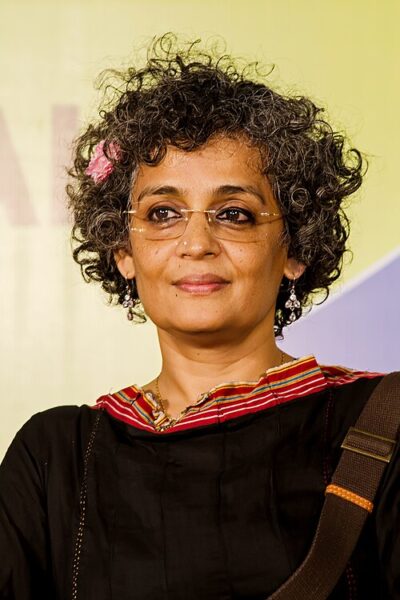
Arundhati Roy
Arundhati Roy is an Indian novelist, essayist, and activist. Born November 24, 1961, in Shillong. Known for The God of Small Things. Educated at University of Delhi and Lawrence School, Lovedale. Awards include Norman Mailer Prize, Sydney Peace Prize and Booker Prize.
Facts
34 facts · 1 confirmed by two sources · 18 cited · 15 from one source
Where this comes from
Papalocal keeps its own record. It started from these sources; what each one said is kept here as it was copied, so a change on their side never changes this page by itself. Tap one to read its version.
What Wikidata says · copied November 16, 2026 · revision 2565590598
- Described as
- Indian novelist, essayist, and activist
- Other names
- Suzanna Arundhati Roy
- Born
- November 24, 1961 · 4 references
- Born in
- Shillong · 2 references
- Citizen of
- India
- Occupation
- novelist · 1 reference; writer · 2 references; screenwriter · 2 references; essayist; film screenwriter · 1 reference; television writer · 1 reference; political activist · 1 reference; actor · 1 reference
- Education
- University of Delhi; Lawrence School, Lovedale; Pallikoodam
- Known for
- The God of Small Things
- Awards
- Norman Mailer Prize (2011); Sydney Peace Prize (2004) · 1 reference; Booker Prize (1997) · 1 reference; National Film Award for Best Screenplay (1988); Lannan Cultural Freedom Prize (2002); Sahitya Akademi Award in English (2005) · 1 reference; Time 100 (2014); Orwell Award (2004); Prix Européen de l'Essai Charles Veillon (2023) · 1 reference
- Field
- essay; activism · 1 reference; film screenwriting · 1 reference; television screenwriting · 1 reference; women's rights · 1 reference; environmental protection · 1 reference
- Spouse
- Pradip Krishen · 1 reference
- Father
- Ranjit Roy
- Mother
- Mary Roy
- Religion
- Hinduism
- Wikipedias with a page
- 96
Wikidata item Q212801 (wikidata.org/wiki/Q212801), public domain (CC0). Copied November 16, 2026.
What Wikipedia says · copied November 16, 2026 · revision 1385913608
Suzanna Arundhati Roy (Bengali pronunciation: [orundʱoti rae̯]; born 24 November 1961) is an Indian author best known for her novel The God of Small Things (1997), which won the Booker Prize for Fiction in 1997 and became the biggest-selling book by a non-expatriate Indian author. She is also a political activist involved in human rights and environmental causes. She was the winner of the 2024 PEN Pinter Prize, given by English PEN, and she named imprisoned British-Egyptian writer and activist Alaa Abd El-Fattah as the "Writer of Courage" with whom she chose to share the award.
- Born, in its opening lines
- November 24, 1961
From the Wikipedia article “Arundhati Roy” (en.wikipedia.org/wiki/Arundhati_Roy), by its contributors, under CC BY-SA 4.0 (creativecommons.org/licenses/by-sa/4.0/). Copied November 16, 2026; not changed.
Confirmed Two sources agree. Cited One source, and it names where it got it. One source One source, without a reference of its own. Sources disagree The sources disagree. We show the best-supported value and keep theirs below.
