
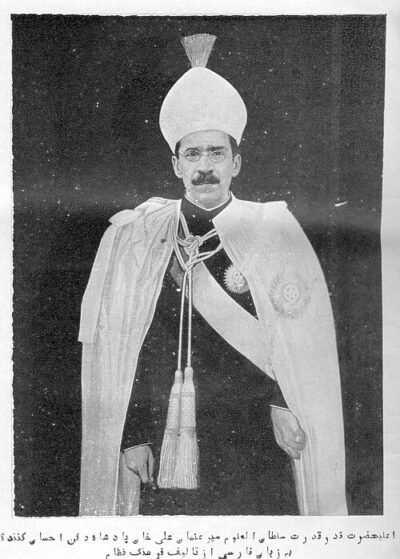
Asaf Jah VII of Hyderabad
Asaf Jah VII of Hyderabad was a Last Monarch of the Kingdom of Hyderabad. Born April 6, 1886, in Hyderabad. Died February 24, 1967, in Hyderabad. Positions held include Member of the Lok Sabha and king. Educated at Aliya High School for Boys. Awards include Knight Grand Cross of the Order of the British Empire, Royal Victorian Chain and Bailiff Grand Cross of the Order of Saint John.
Facts
21 facts · 2 confirmed by two sources · 2 cited · 16 from one source · 1 where the sources disagree
What’s different
- Born in: we show Hyderabad (Sources disagree). Wikidata also lists Hyderabad State
Where this comes from
Papalocal keeps its own record. It started from these sources; what each one said is kept here as it was copied, so a change on their side never changes this page by itself. Tap one to read its version.
What Wikidata says · copied November 16, 2026 · revision 2568092155
- Described as
- Last Monarch of the Kingdom of Hyderabad (1886-1967)
- Other names
- Osman Ali Pasha, Asaf Jah 7, Nizam sarkar, 7th nizam, Nizam VII, Osman Ali Khan, Mir Osman Ali khan, Sir Mir Osman Ali Khan
- Born
- April 6, 1886 · 4 references
- Died
- February 24, 1967 · 4 references
- Born in
- Hyderabad; Hyderabad State
- Died in
- Hyderabad
- Citizen of
- Hyderabad State (1911–)
- Occupation
- politician; ruler; monarch
- Positions held
- Member of the Lok Sabha; king · 1 reference
- Education
- Aliya High School for Boys
- Member of
- Hyderabadi Royal Family
- Awards
- Knight Grand Cross of the Order of the British Empire (1917) · 1 reference; Royal Victorian Chain (1946); Bailiff Grand Cross of the Order of Saint John · 1 reference
- Spouse
- Queen Azam-un-Nisa of Hyderabad
- Children
- Prince Azam Jah, Prince of Berar; Prince Moazzam Jah of Hyderabad
- Father
- Asaf Jah VI of Hyderabad
- Mother
- Queen Amat-uz-Zehra, Queen Mother of Hyderabad
- Religion
- Sunni Islam
- Wikipedias with a page
- 37
Wikidata item Q468298 (wikidata.org/wiki/Q468298), public domain (CC0). Copied November 16, 2026.
What Wikipedia says · copied November 16, 2026 · revision 1382080582
Mir Osman Ali Khan, Asaf Jah VII (5 or 6 April 1886 – 24 February 1967) was the last Nizam (ruler) of Hyderabad State, the largest state in the erstwhile British Indian Empire. He ascended the throne on 29 August 1911, at the age of 25 and ruled the State of Hyderabad until 1948, when the Indian Union annexed it. He was styled as His Exalted Highness (H.E.H) the Nizam of Hyderabad, and was widely considered one of the world's wealthiest people of all time. With some estimates placing his wealth at 2% of U.S. GDP, his portrait was on the cover of Time magazine in 1937. As a semi-autonomous monarch, he had his mint, printing his currency, the Hyderabadi rupee, and had a private treasury that was said to contain £100 million in gold and silver bullion, and a further £400 million of jewels (in 2008 terms). The major source of his wealth was the Golconda mines, the only supplier of diamonds in the world at that time. Among them was the Jacob Diamond, valued at some £50 million (in 2008 terms), and used by the Nizam as a paperweight.
During his 37-year rule, electricity was introduced, and railways, roads, and airports were developed. He was known as the "Architect of modern Hyderabad" and is credited with establishing many public institutions in the city of Hyderabad, including Osmania University, Osmania General Hospital, State Bank of Hyderabad, Begumpet Airport, and the Hyderabad High Court. Two reservoirs, Osman Sagar and Himayat Sagar, were built during his reign, to prevent future flooding after the Great Musi Flood of 1908 in the city. The Nizam also constructed the Nizam Sagar Dam and, in 1923, a reservoir was constructed across the Manjira River, a tributary of the Godavari River, between Achampet (Nizamabad) and Banjepally villages of Kamareddy district in Telangana, India. It is located at about 144 km (89 mi) northwest of Hyderabad and is the oldest dam in the state.
The Nizam had refused to accede Hyderabad to India after the country's independence on 15 August 1947. He wanted his domains to remain an independent state or join Pakistan. Later, he wanted his state to join India; however, his power had weakened because of the Telangana Rebellion and the rise of a radical militia known as the Razakars, whom he could not put down. In 1948, the Indian Army invaded and annexed Hyderabad State and defeated the Razakars. The Nizam became the Rajpramukh of Hyderabad State between 1950 and 1956, after which the state was partitioned and became part of Andhra Pradesh, Karnataka, and Maharashtra.
In 1951, he started the construction of Nizam Orthopedic Hospital (now known as Nizam's Institute of Medical Sciences (NIMS)) and leased it to the government for 99 years for a monthly rent of Rs.1. He also donated 14,000 acres (5,700 ha) of land from his estate to Vinobha Bhave's Bhoodan movement for re-distribution among landless farmers.
- Born, in its opening lines
- April 6, 1886
- Died, in its opening lines
- February 24, 1967
From the Wikipedia article “Mir Osman Ali Khan” (en.wikipedia.org/wiki/Mir_Osman_Ali_Khan), by its contributors, under CC BY-SA 4.0 (creativecommons.org/licenses/by-sa/4.0/). Copied November 16, 2026; not changed.
Confirmed Two sources agree. Cited One source, and it names where it got it. One source One source, without a reference of its own. Sources disagree The sources disagree. We show the best-supported value and keep theirs below.
