
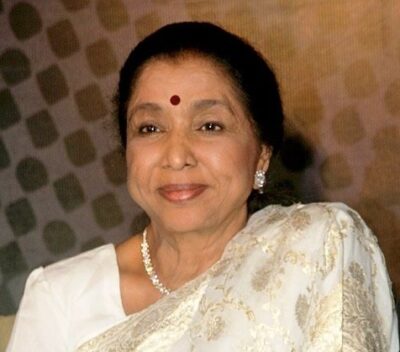
Asha Bhosle
Asha Bhosle was an Indian playback singer. Born September 8, 1933, in Sangli. Died April 12, 2026, in Mumbai. Known for list of songs recorded by Asha Bhosle. Educated at Balmohan Vidyamandir. Awards include Dadasaheb Phalke Award, Padma Vibhushan and BBC 100 Women.
Facts
40 facts · 2 confirmed by two sources · 5 cited · 33 from one source
Where this comes from
Papalocal keeps its own record. It started from these sources; what each one said is kept here as it was copied, so a change on their side never changes this page by itself. Tap one to read its version.
What Wikidata says · copied November 16, 2026 · revision 2567025103
- Described as
- Indian playback singer (1933–2026)
- Other names
- Asha Bhonsale, Asha Bhonsle, Asha Mangeshkar
- Born
- September 8, 1933 · 1 reference
- Died
- April 12, 2026 · 1 reference
- Born in
- Sangli
- Died in
- Mumbai · 1 reference
- Cause of death
- cardiac arrest
- Citizen of
- British Raj (1933–1947); India (1947–)
- Occupation
- actor; singer; guitarist; composer; film actor; playback singer · 1 reference; musician · 1 reference
- Education
- Balmohan Vidyamandir
- Genre
- Indian film music; Hindustani classical music; world music; Indian classical music; Indian folk music; Indian rock
- Instrument
- guitar; voice
- Record label
- His Master's Voice; Columbia Graphophone Co. Ltd.
- Known for
- list of songs recorded by Asha Bhosle · 1 reference
- Awards
- Dadasaheb Phalke Award (2000); Padma Vibhushan (2008); BBC 100 Women (2015) · 1 reference; National Film Award for Best Female Playback Singer (1988) · 1 reference; IIFA Lifetime Achievement Award
- Spouse
- Rahul Dev Burman (1980–1994) · 1 reference
- Children
- Varsha Bhosle
- Father
- Deenanath Mangeshkar
- Siblings
- Lata Mangeshkar · 1 reference; Usha Mangeshkar; Meena Khadikar; Hridaynath Mangeshkar · 1 reference
- Religion
- Hinduism
- Website
- http://ashabhosle.com · 1 reference
- Wikipedias with a page
- 60
Wikidata item Q38393 (wikidata.org/wiki/Q38393), public domain (CC0). Copied November 16, 2026.
What Wikipedia says · copied November 16, 2026 · revision 1384070581
Asha Bhosle (née Mangeshkar; 8 September 1933 – 12 April 2026) was an Indian playback singer and actress who predominantly worked in Indian cinema. Known for her versatility, she was described in the media as one of the greatest and most influential singers in Hindi cinema. In a career spanning over eight decades, she recorded songs for films and albums in various Indian languages and won several accolades including two National Film Awards, four BFJA Awards, eighteen Maharashtra State Film Awards, nine Filmfare Awards including a Lifetime Achievement Award and a record seven Filmfare Awards for Best Female Playback Singer, in addition to two Grammy nominations. In 2000, she was honoured with the Dadasaheb Phalke Award, India's highest award in the field of cinema. In 2008, she was honoured by the Government of India with the Padma Vibhushan, the second-highest civilian honour of the country. The Guinness Book of World Records acknowledged her in 2011 as the most recorded artist in music history.
Bhosle was the younger sister of playback singer Lata Mangeshkar and belonged to the prominent Mangeshkar family. Renowned for her soprano voice range and often credited with her versatility, her work included film music, pop, ghazals, bhajans, traditional Indian classical music, folk songs, qawwalis, and Rabindra Sangeet. Apart from Hindi, she sang in over 20 Indian and foreign languages. In 2013, she made her debut as an actress in the film Mai, and received critical acclaim for her performance. In 2006, she stated that she had recorded over 12,000 songs in her career, a figure repeated by several other sources.
- Born, in its opening lines
- September 8, 1933
- Died, in its opening lines
- April 12, 2026
From the Wikipedia article “Asha Bhosle” (en.wikipedia.org/wiki/Asha_Bhosle), by its contributors, under CC BY-SA 4.0 (creativecommons.org/licenses/by-sa/4.0/). Copied November 16, 2026; not changed.
Confirmed Two sources agree. Cited One source, and it names where it got it. One source One source, without a reference of its own. Sources disagree The sources disagree. We show the best-supported value and keep theirs below.
