
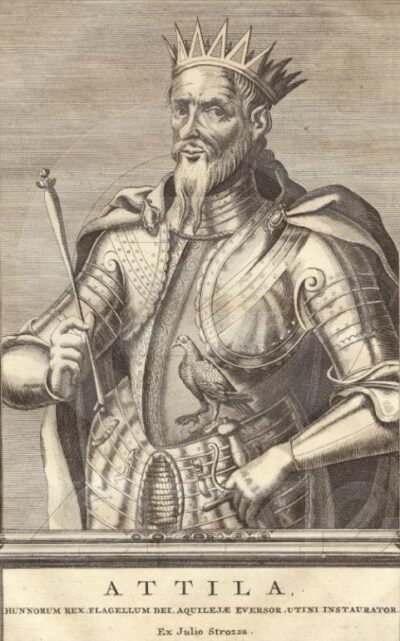
Attila
Attila was the 5th-century ruler of the Hunnic Empire. Born 500. Died 453, in Pannonia. Positions held include king of the Huns (435–453).
Facts
15 facts · 1 confirmed by two sources · 1 cited · 12 from one source · 1 where the sources disagree
What’s different
- Born: we show 500 (Sources disagree). Wikipedia says 406
Where this comes from
Papalocal keeps its own record. It started from these sources; what each one said is kept here as it was copied, so a change on their side never changes this page by itself. Tap one to read its version.
What Wikidata says · copied November 16, 2026 · revision 2566536556
- Described as
- 5th-century ruler of the Hunnic Empire
- Other names
- the Hun Attila, King of the Huns Attila, Attyla, Atilla, Attila the Hun
- Born
- 500 · 2 references
- Died
- 453 · 12 references
- Died in
- Pannonia · 1 reference
- Cause of death
- choking · 1 reference
- Citizen of
- Hunnic Empire
- Occupation
- traditional leader or chief
- Positions held
- king of the Huns (435–453)
- Spouse
- Kreka; Ildico; Eskam's daughter
- Children
- Ellac; Dengizich; Ernakh
- Father
- Mundzuk
- Siblings
- Bleda
- Wikipedias with a page
- 118
Wikidata item Q36724 (wikidata.org/wiki/Q36724), public domain (CC0). Copied November 16, 2026.
What Wikipedia says · copied November 16, 2026 · revision 1385942108
Attila ( ə-TIL-ə or AT-il-ə; c. 406 – 453), frequently called Attila the Hun and also known by his nickname The Scourge of God, was the ruler of the Huns from 434 until his death in early 453. He was also the leader of an empire consisting of Huns, Ostrogoths, Alans, and Gepids, among others, in Central and Eastern Europe.
As nephews to Rugila, Attila and his elder brother Bleda succeeded him to the throne in 435, ruling jointly until the death of Bleda in 445. During his reign, Attila was one of the most feared enemies of the Western and Eastern Roman Empires. He crossed the Danube twice and plundered the Balkans but was unable to take Constantinople, stopped by the double walls of the Eastern capital. The Huns defeated a second army near Callipolis (Gelibolu). In 441, he led an invasion of the Eastern Roman (Byzantine) Empire, the success of which emboldened him to invade the West. He also attempted to conquer Roman Gaul (modern France), crossing the Rhine in 451 and marching as far as Aurelianum (Orléans), before being stopped in the Battle of the Catalaunian Plains.
He subsequently invaded Italy, devastating the northern provinces, but was unable to take Rome. He planned for further campaigns against the Romans but died in 453. After Attila's death, his close adviser, Ardaric of the Gepids, led a successful revolt against Hunnic rule, after which the Hunnic Empire quickly collapsed. Attila lived on as a character in Germanic heroic legend.
- Born, in its opening lines
- 406
- Died, in its opening lines
- 453
From the Wikipedia article “Attila” (en.wikipedia.org/wiki/Attila), by its contributors, under CC BY-SA 4.0 (creativecommons.org/licenses/by-sa/4.0/). Copied November 16, 2026; not changed.
Confirmed Two sources agree. Cited One source, and it names where it got it. One source One source, without a reference of its own. Sources disagree The sources disagree. We show the best-supported value and keep theirs below.
