
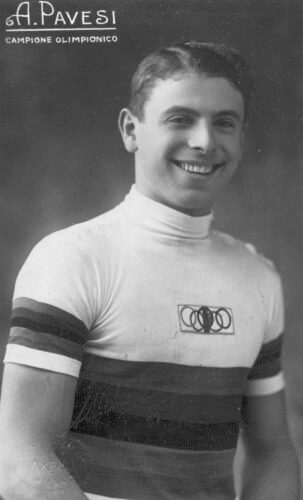
Attilio Pavesi
Attilio Pavesi was an Italian-Argentine cyclist. Born October 1, 1910, in Caorso. Died August 2, 2011, in Buenos Aires.
Facts
9 facts · 2 confirmed by two sources · 0 cited · 7 from one source
Where this comes from
Papalocal keeps its own record. It started from these sources; what each one said is kept here as it was copied, so a change on their side never changes this page by itself. Tap one to read its version.
What Wikidata says · copied November 17, 2026 · revision 2547997188
- Described as
- Italian-Argentine cyclist (1910–2011)
- Born
- October 1, 1910
- Died
- August 2, 2011 · 1 reference
- Born in
- Caorso
- Died in
- Buenos Aires
- Citizen of
- Italy (1946–); Kingdom of Italy (–1946)
- Occupation
- sport cyclist
- Sport
- road bicycle racing
- Height
- 1.67 m (5 ft 6 in) · 1 reference
- Wikipedias with a page
- 25
Wikidata item Q514253 (wikidata.org/wiki/Q514253), public domain (CC0). Copied November 17, 2026.
What Wikipedia says · copied November 17, 2026 · revision 1380399273
Attilio Pavesi (1 October 1910 – 2 August 2011) was an Italian cyclist who won the individual and team road races at the 1932 Summer Olympics. The same year he placed second in the Giro di Sicilia, and in 1933–35 rode as professional, but with no success.
Pavesi was the 11th child in an affluent family in Caorso, Emilia-Romagna. At the beginning of World War II he immigrated to San Miguel, Buenos Aires, Argentina, where he continued racing, ran his bike shop, and organized cycling races. He died at the age of 100 in a retirement home in Buenos Aires. At the time of his death he was thought to be the oldest surviving Olympic champion and one of the oldest living Olympic competitors.
- Born, in its opening lines
- October 1, 1910
- Died, in its opening lines
- August 2, 2011
From the Wikipedia article “Attilio Pavesi” (en.wikipedia.org/wiki/Attilio_Pavesi), by its contributors, under CC BY-SA 4.0 (creativecommons.org/licenses/by-sa/4.0/). Copied November 17, 2026; not changed.
Confirmed Two sources agree. Cited One source, and it names where it got it. One source One source, without a reference of its own. Sources disagree The sources disagree. We show the best-supported value and keep theirs below.
