
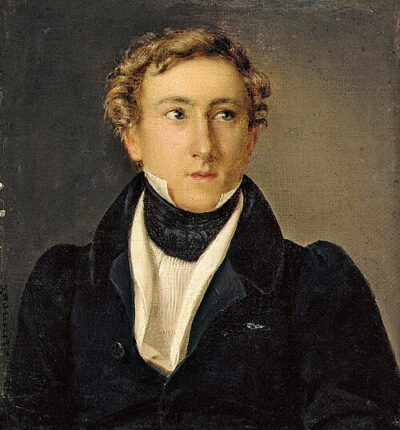
August Bournonville
August Bournonville was a Danish ballet master and choreographer. Born August 21, 1805, in Copenhagen. Died November 30, 1879, in Copenhagen. Awards include Knight of the Order of the Dannebrog, Decoration of the Cross of Honour of the Dannebrog and Medal of Merit in Gold.
Facts
18 facts · 2 confirmed by two sources · 9 cited · 7 from one source
Where this comes from
Papalocal keeps its own record. It started from these sources; what each one said is kept here as it was copied, so a change on their side never changes this page by itself. Tap one to read its version.
What Wikidata says · copied November 18, 2026 · revision 2567936112
- Described as
- Danish ballet master and choreographer (1805–1879)
- Other names
- Anton August Bournonville
- Born
- August 21, 1805 · 13 references
- Died
- November 30, 1879 · 12 references
- Born in
- Copenhagen · 3 references
- Died in
- Copenhagen · 3 references
- Buried in
- Asminderød Kirkegård · 2 references
- Citizen of
- Kingdom of Denmark; France
- Occupation
- ballet master · 2 references; choreographer · 1 reference; ballet dancer · 1 reference; dancer · 1 reference
- Awards
- Knight of the Order of the Dannebrog (1848) · 2 references; Decoration of the Cross of Honour of the Dannebrog (1860) · 2 references; Medal of Merit in Gold (1867) · 2 references; Knight of the Order of Vasa · 1 reference
- Spouse
- Helena Frederika Håkansson
- Children
- Charlotte Bournonville
- Father
- Antoine Bournonville · 1 reference
- Wikipedias with a page
- 24
Wikidata item Q448812 (wikidata.org/wiki/Q448812), public domain (CC0). Copied November 18, 2026.
What Wikipedia says · copied November 18, 2026 · revision 1348338014
August Bournonville (21 August 1805 – 30 November 1879) was a Danish ballet master and choreographer. He was the son of Antoine Bournonville, a dancer and choreographer trained under the French choreographer, Jean Georges Noverre, and the nephew of Julie Alix de la Fay, née Bournonville, of the Royal Swedish Ballet.
Bournonville was born in Copenhagen, Denmark, where his father had settled. He trained with his father Antoine Bournonville. He also studied under the Italian choreographer Vincenzo Galeotti at the Royal Danish Ballet, Copenhagen, and in Paris, France, under French dancer Auguste Vestris. He initiated a unique style in ballet known as the Bournonville School.
Following studies in Paris as a young man, Bournonville became solo dancer at the Royal Ballet in Copenhagen. From 1830 to 1848 he was choreographer for the Royal Danish Ballet, for which he created more than 50 ballets admired for their exuberance, lightness and beauty. He created a style which, although influenced from the Paris ballet, is entirely his own. As a choreographer, he created a number of ballets with varied settings that range from Denmark to Italy, Russia to South America. A limited number of these works have survived.
Bournonville's work became known outside Denmark only after World War II. Since 1950, The Royal Ballet has several times made prolonged tours abroad, not the least to the United States, where they have performed his ballets.
Bournonville's best-known ballets are La Sylphide (1836), Napoli (1842), Le Conservatoire (1849), The Kermesse in Bruges (1851) and A Folk Tale (1854). Later major ballets include Valkyrien, Thrymskviden, Arcona and Fjedstuen.
- Born, in its opening lines
- August 21, 1805
- Died, in its opening lines
- November 30, 1879
From the Wikipedia article “August Bournonville” (en.wikipedia.org/wiki/August_Bournonville), by its contributors, under CC BY-SA 4.0 (creativecommons.org/licenses/by-sa/4.0/). Copied November 18, 2026; not changed.
Confirmed Two sources agree. Cited One source, and it names where it got it. One source One source, without a reference of its own. Sources disagree The sources disagree. We show the best-supported value and keep theirs below.
