
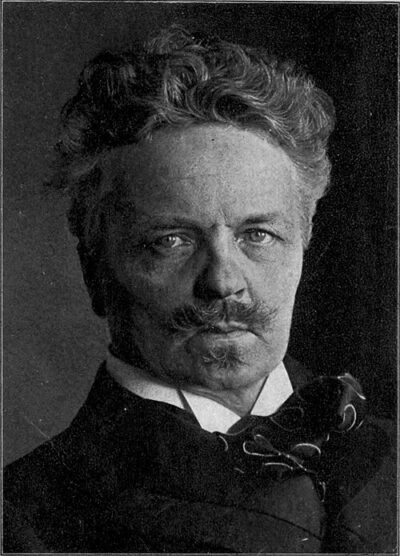
August Strindberg
August Strindberg was a Swedish writer and painter. Born January 22, 1849, in Stockholm. Died May 14, 1912, in Adolf Fredriks parish. Known for The Red Room, The Father and Miss Julie. Educated at Uppsala University.
Facts
47 facts · 2 confirmed by two sources · 13 cited · 32 from one source
Where this comes from
Papalocal keeps its own record. It started from these sources; what each one said is kept here as it was copied, so a change on their side never changes this page by itself. Tap one to read its version.
What Wikidata says · copied November 16, 2026 · revision 2563924774
- Described as
- Swedish writer and painter (1849–1912)
- Other names
- A. Sṭrindberg, Augusts Strindbergs, August Johan Strindberg, Sutorintoberuku, Johan August Strindberg
- Born
- January 22, 1849 · 25 references
- Died
- May 14, 1912 · 24 references
- Born in
- Stockholm · 3 references
- Died in
- Adolf Fredriks parish · 2 references
- Buried in
- Norra begravningsplatsen (1912–) · 4 references
- Cause of death
- stomach cancer
- Citizen of
- Sweden
- Occupation
- playwright · 2 references; poet; photographer · 1 reference; painter · 4 references; novelist · 2 references; autobiographer; screenwriter; writer · 4 references
- Education
- Uppsala University · 1 reference
- Known for
- The Red Room · 1 reference; The Father · 1 reference; Miss Julie · 1 reference; Inferno · 1 reference; To Damascus · 1 reference; A Dream Play · 1 reference; Kristina; The People of Hemsö
- Field
- literature · 1 reference; creative and professional writing · 1 reference; prose · 1 reference; drama · 1 reference
- Spouse
- Siri von Essen (1877–1893) · 1 reference; Frida Uhl (1893–1897) · 1 reference; Harriet Bosse (1901–1904) · 1 reference
- Children
- Karin Smirnov · 1 reference; Anne-Marie Hagelin · 1 reference; Kerstin Strindberg; Greta Strindberg; Friedrich Strindberg · 1 reference
- Father
- Carl Oscar Strindberg
- Mother
- Eleonora Ulrika Strindberg
- Siblings
- Nora Strindberg; Elisabeth Strindberg; Carl Axel Strindberg
- Religion
- atheism
- Lived in
- Sundhetskollegiets hus (1849–1851) · 1 reference; Stockholm (2 times) (1856–) · 1 reference; Uppsala (1870–1879) · 1 reference; Berlin (1891–) · 2 references; Taarbæk parish (1887–1889) · 1 reference
- Wikipedias with a page
- 118
Wikidata item Q7724 (wikidata.org/wiki/Q7724), public domain (CC0). Copied November 16, 2026.
What Wikipedia says · copied November 16, 2026 · revision 1383951710
Johan August Strindberg (; Swedish: [ˈǒːɡɵst ˈstrɪ̂nːdbærj] ; 22 January 1849 – 14 May 1912) was a Swedish playwright, novelist, poet, essayist, and painter. A prolific writer who often drew directly on his personal experience, Strindberg wrote more than 60 plays and more than 30 works of fiction, autobiography, history, cultural analysis, and politics during his career, which spanned four decades. A bold experimenter and iconoclast throughout his life, he explored a wide range of dramatic methods and purposes, from naturalistic tragedy, monodrama, and historical plays to his anticipations of expressionist and surrealist dramatic techniques. From his earliest work, Strindberg developed innovative forms of dramatic action, language, and visual composition. He is considered the "father" of modern Swedish literature and his The Red Room (1879) has frequently been described as the first modern Swedish novel. In Sweden, Strindberg is known as an essayist, painter, poet, and especially novelist and playwright, but in other countries he is known mostly as a playwright.
The Royal Theatre rejected his first major play, Master Olof, in 1872; it was not until 1881, when he was thirty-two, that its première at the New Theatre gave him his theatrical breakthrough. In his plays The Father (1887), Miss Julie (1888), and Creditors (1889), he created naturalistic dramas that – building on the established accomplishments of Henrik Ibsen's prose problem plays while rejecting their use of the structure of the well-made play – responded to the call-to-arms of Émile Zola's manifesto "Naturalism in the Theatre" (1881) and the example set by André Antoine's newly established Théâtre Libre (opened 1887). In Miss Julie, characterisation replaces plot as the predominant dramatic element (in contrast to melodrama and the well-made play) and the determining role of heredity and the environment on the "vacillating, disintegrated" characters is emphasized. Strindberg modeled his short-lived Scandinavian Experimental Theatre (1889) in Copenhagen on Antoine's theatre and he explored the theory of Naturalism in his essays "On Psychic Murder" (1887), "On Modern Drama and the Modern Theatre" (1889), and a preface to Miss Julie, the last of which is probably the best-known statement of the principles of the theatrical movement.
During the 1890s he spent significant time abroad engaged in scientific experiments and studies of the occult. A series of apparent psychotic attacks between 1894 and 1896 (referred to as his "Inferno crisis") led to his hospitalization and return to Sweden. Under the influence of the ideas of Emanuel Swedenborg, he resolved after his recovery to become "the Zola of the Occult". In 1898 he returned to play-writing with To Damascus, which, like The Great Highway (1909), is a dream-play of spiritual pilgrimage. His A Dream Play (1902) – with its radical attempt to dramatize the workings of the unconscious by means of an abolition of conventional dramatic time and space and the splitting, doubling, merging, and multiplication of its characters – was an important precursor to both expressionism and surrealism. He also returned to writing historical drama, the genre with which he had begun his play-writing career. He helped to run the Intimate Theatre from 1907, a small-scale theatre in Stockholm, modeled on Max Reinhardt's Kammerspielhaus, that staged his chamber plays (such as The Ghost Sonata).
- Born, in its opening lines
- January 22, 1849
- Died, in its opening lines
- May 14, 1912
From the Wikipedia article “August Strindberg” (en.wikipedia.org/wiki/August_Strindberg), by its contributors, under CC BY-SA 4.0 (creativecommons.org/licenses/by-sa/4.0/). Copied November 16, 2026; not changed.
Confirmed Two sources agree. Cited One source, and it names where it got it. One source One source, without a reference of its own. Sources disagree The sources disagree. We show the best-supported value and keep theirs below.
