
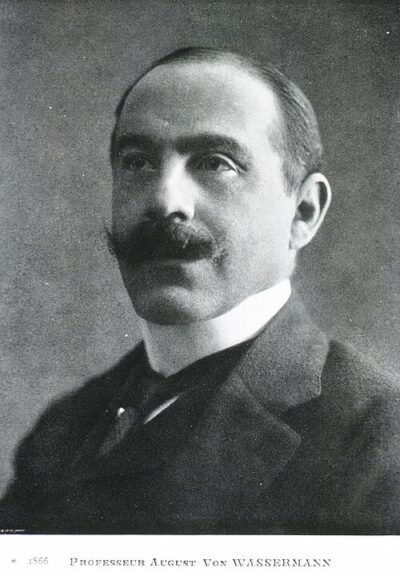
August von Wassermann
August von Wassermann was a German bacteriologist. Born February 21, 1866, in Bamberg. Died March 16, 1925, in Berlin. Educated at LMU Munich and University of Vienna. Awards include Aronson Prize.
Facts
21 facts · 2 confirmed by two sources · 4 cited · 15 from one source
Where this comes from
Papalocal keeps its own record. It started from these sources; what each one said is kept here as it was copied, so a change on their side never changes this page by itself. Tap one to read its version.
What Wikidata says · copied November 16, 2026 · revision 2569222260
- Described as
- German bacteriologist (1866-1925)
- Other names
- August Wassermann, August Paul von Wassermann
- Born
- February 21, 1866 · 4 references
- Died
- March 16, 1925 · 6 references
- Born in
- Bamberg · 2 references
- Died in
- Berlin · 2 references
- Buried in
- Urnenfriedhof Gerichtstraße
- Name at birth
- August Paul von Wassermann
- Citizen of
- German Empire
- Occupation
- biologist; physician · 1 reference; immunologist; university teacher · 1 reference; bacteriologist · 1 reference
- Education
- LMU Munich; University of Vienna; University of Strasbourg; University of Strasbourg
- Awards
- Aronson Prize (1921)
- Field
- medicine; microbiology; immunology
- Military rank
- brigadier general
- Wikipedias with a page
- 32
Wikidata item Q77360 (wikidata.org/wiki/Q77360), public domain (CC0). Copied November 16, 2026.
What Wikipedia says · copied November 16, 2026 · revision 1348367022
August Paul von Wassermann (21 February 1866 – 16 March 1925) was a German bacteriologist and hygienist.
Born in Bamberg, with Jewish origins, he studied at several universities throughout Germany, receiving his medical doctorate in 1888 from the University of Strassburg. In 1890 he began work under Robert Koch at the Institute for Infectious Diseases in Berlin. In 1906 he became director of the division for experimental therapy and serum research at the institute, followed by a directorship of the department of experimental therapy at the Kaiser-Wilhelm-Gesellschaft for the Advancement of Science in Berlin-Dahlem (1913).
Wassermann developed a complement fixation test for the diagnosis of syphilis in 1906, just one year after the causative organism, Spirochaeta pallida, had been identified by Fritz Schaudinn and Erich Hoffmann. The so-called "Wassermann test" allowed for early detection of the disease (despite its nonspecific symptoms), and thus prevention of transmission. He attributed the development of the test to earlier findings of Jules Bordet and Octave Gengou (complement fixation reaction) and to a hypothesis introduced by Paul Ehrlich in his interpretation of antibody formation.
The Wassermann test remains a staple of syphilis detection and prevention in some areas, although it has often been replaced by more modern alternatives. With Wilhelm Kolle, he published the six-volume Handbuch der Pathogenen Mikroorganismen (Handbook of Pathogenic Microorganisms).
He was the first recipient of the Aronson Prize in 1921.
- Born, in its opening lines
- February 21, 1866
- Died, in its opening lines
- March 16, 1925
From the Wikipedia article “August von Wassermann” (en.wikipedia.org/wiki/August_von_Wassermann), by its contributors, under CC BY-SA 4.0 (creativecommons.org/licenses/by-sa/4.0/). Copied November 16, 2026; not changed.
Confirmed Two sources agree. Cited One source, and it names where it got it. One source One source, without a reference of its own. Sources disagree The sources disagree. We show the best-supported value and keep theirs below.
