
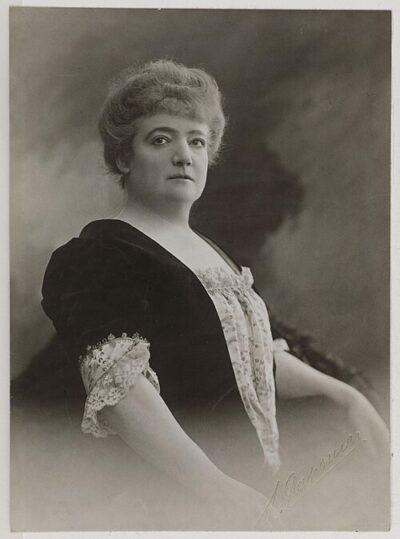
Augusta Holmès
Augusta Holmès was a French composer of British-Irish origin. Born December 16, 1847, in former 1st arrondissement of Paris. Died January 28, 1903, in 17th arrondissement of Paris. Known for La Montagne noire, Les Argonautes and Lutèce. Awards include Officier de l'Instruction publique.
Facts
36 facts · 2 confirmed by two sources · 4 cited · 29 from one source · 1 where the sources disagree
What’s different
- Buried in: we show Cemetery of Saint-Louis, Versailles (Sources disagree). Wikidata also lists grave of Augusta Holmès
Where this comes from
Papalocal keeps its own record. It started from these sources; what each one said is kept here as it was copied, so a change on their side never changes this page by itself. Tap one to read its version.
What Wikidata says · copied November 18, 2026 · revision 2567368152
- Described as
- French composer of British-Irish origin
- Other names
- Augusta Mary Anne Holmès, Augusta Holmes, Hermann Zenta, Augusta Mary Anne Holmes
- Born
- December 16, 1847 · 5 references
- Died
- January 28, 1903 · 7 references
- Born in
- former 1st arrondissement of Paris · 2 references
- Died in
- 17th arrondissement of Paris · 2 references
- Buried in
- Cemetery of Saint-Louis, Versailles; grave of Augusta Holmès
- Cause of death
- myocardial infarction
- Name at birth
- Augusta Mary Anne Holmes
- Citizen of
- France (1879–); United Kingdom of Great Britain and Ireland
- Occupation
- classical composer; pianist · 1 reference; poet · 1 reference; writer; composer · 1 reference
- Genre
- opera; chamber music; symphonic music; song
- Instrument
- piano; pipe organ; clarinet
- Known for
- La Montagne noire; Les Argonautes; Lutèce; Roland furieux; Irlande; Andromède; Pologne; Ludus pro patria
- Awards
- Officier de l'Instruction publique
- Field
- piano repertoire
- Spouse
- Catulle Mendès
- Children
- Jeanne Huguette Olga Mendès; Hélyonne Mendès; Marie Anne Claudine Mendès; Raphaël Henri Mendès
- Wikipedias with a page
- 23
Wikidata item Q464636 (wikidata.org/wiki/Q464636), public domain (CC0). Copied November 18, 2026.
What Wikipedia says · copied November 18, 2026 · revision 1376467084
Augusta Mary Anne Holmès (née Holmes; 16 December 1847 – 28 January 1903), also known by the pseudonym Hermann Zenta, was a French and Irish composer. Holmès wrote the texts to almost all of her vocal music herself, including songs, oratorios, the libretto of her opera La Montagne noire and the programmatic poems for her symphonic poems including Irlande and Andromède.
- Born, in its opening lines
- December 16, 1847
- Died, in its opening lines
- January 28, 1903
From the Wikipedia article “Augusta Holmès” (en.wikipedia.org/wiki/Augusta_Holmès), by its contributors, under CC BY-SA 4.0 (creativecommons.org/licenses/by-sa/4.0/). Copied November 18, 2026; not changed.
Confirmed Two sources agree. Cited One source, and it names where it got it. One source One source, without a reference of its own. Sources disagree The sources disagree. We show the best-supported value and keep theirs below.
