
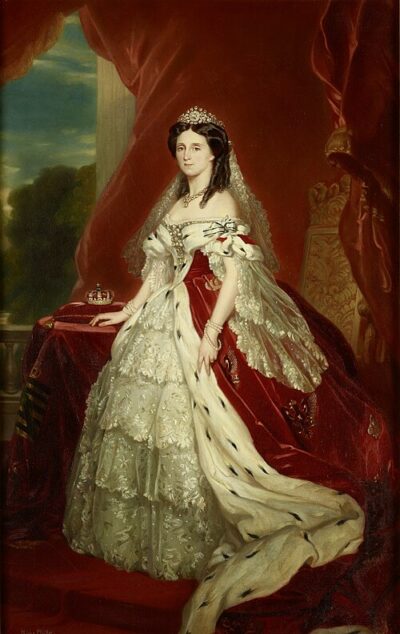
Augusta of Saxe-Weimar-Eisenach
Augusta of Saxe-Weimar-Eisenach was a German empress. Born September 30, 1811, in Weimar. Died January 7, 1890, in Berlin. Positions held include empress. Awards include Order of the Black Eagle and Order of Louise.
Facts
21 facts · 2 confirmed by two sources · 3 cited · 16 from one source
Where this comes from
Papalocal keeps its own record. It started from these sources; what each one said is kept here as it was copied, so a change on their side never changes this page by itself. Tap one to read its version.
What Wikidata says · copied November 16, 2026 · revision 2568863221
- Described as
- German empress (1811-1890)
- Other names
- Maria Luise Augusta Catharine, Princess Augusta Marie Luise Katharina of Saxe-Weimar-Eisenach
- Born
- September 30, 1811 · 8 references
- Died
- January 7, 1890 · 7 references
- Born in
- Weimar · 2 references
- Died in
- Berlin · 2 references
- Buried in
- mausoleum of Charlottenburg Park
- Cause of death
- influenza
- Name at birth
- Augusta Marie Luise Katharina von Sachsen-Weimar-Eisenach
- Citizen of
- Kingdom of Prussia
- Occupation
- consort; composer · 1 reference
- Positions held
- empress
- Awards
- Order of the Black Eagle; Order of Louise
- Spouse
- Wilhelm I (1829–1888) · 1 reference
- Children
- Frederick III, German Emperor; Princess Louise of Prussia
- Father
- Carl Friedrich I, Grand Duke of Saxe-Weimar-Eisenach
- Mother
- Grand Duchess Maria Pavlovna of Russia
- Siblings
- Carl Alexander I, Grand Duke of Saxe-Weimar-Eisenach; Princess Marie of Saxe-Weimar-Eisenach
- Religion
- Protestantism
- Wikipedias with a page
- 39
Wikidata item Q57541 (wikidata.org/wiki/Q57541), public domain (CC0). Copied November 16, 2026.
What Wikipedia says · copied November 16, 2026 · revision 1384420384
Augusta of Saxe-Weimar-Eisenach (Maria Luise Augusta Katharina; 30 September 1811 – 7 January 1890), was Queen of Prussia and the first German Empress as the wife of William I, German Emperor.
A member of the Grand Ducal House of Saxe-Weimar-Eisenach and closely related to the Russian Imperial House of Romanov through her mother Grand Duchess Maria Pavlovna, in June 1829, Augusta married Prince William of Prussia. The marriage was tense; Wilhelm actually wanted to marry his cousin, Elisa Radziwiłł, who was judged to be unsuitable by the Prussian court, and the political views and intellectual interests of the two spouses were also far apart. Despite personal differences, Augusta and William often worked together to handle correspondence and social gatherings at court. In 1831 and 1838, they had two children, Frederick William and Louise. After the death of her father-in-law King Frederick William III of Prussia in 1840, Augusta became the wife of the heir presumptive to the Prussian throne.
It was not an official position that gave Augusta political influence, but rather her social relationships and dynastic proximity to William. An important role was played by extensive correspondence with her husband, other princes, statesmen, officers, diplomats, clergy, scientists and writers. She saw herself as her husband's political advisor and saw the Prussian Prime Minister and German Chancellor Otto von Bismarck as her main political enemy. While Bismarck biographies sometimes characterize the Empress's political views as anti-liberal or as destructive directed solely against Bismarck's policies, more recent research classifies them as liberal. Accordingly, Augusta did not succeed overall in convincing her husband to restructure Prussia and Germany along the lines of United Kingdom's constitutional monarchy. Nevertheless, she certainly had political leeway in raising the heir to the throne, as an advocate for the Catholic population and through her access to the king and anti-militaristic representation. Exactly how far Augusta's influence as a monarch's wife went in the 19th century is still being debated in historiography.
- Born, in its opening lines
- September 30, 1811
- Died, in its opening lines
- January 7, 1890
From the Wikipedia article “Augusta of Saxe-Weimar-Eisenach” (en.wikipedia.org/wiki/Augusta_of_Saxe-Weimar-Eisenach), by its contributors, under CC BY-SA 4.0 (creativecommons.org/licenses/by-sa/4.0/). Copied November 16, 2026; not changed.
Confirmed Two sources agree. Cited One source, and it names where it got it. One source One source, without a reference of its own. Sources disagree The sources disagree. We show the best-supported value and keep theirs below.
