
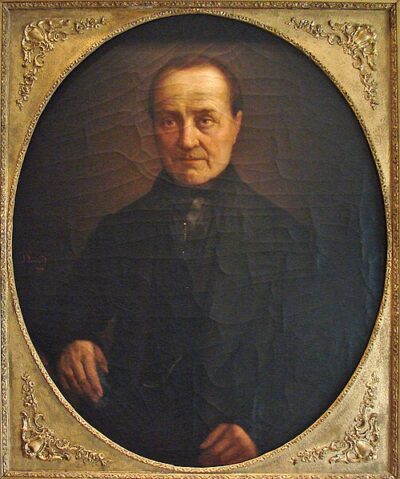
Auguste Comte
Auguste Comte was a French philosopher, mathematician and sociologist. Born January 19, 1798, in Montpellier. Died September 5, 1857, in Paris. Educated at Lycée Joffre and École polytechnique. Awards include Knight of the Legion of Honour.
Facts
22 facts · 2 confirmed by two sources · 8 cited · 11 from one source · 1 where the sources disagree
What’s different
- Buried in: we show Père Lachaise Cemetery (Sources disagree). Wikidata also lists Grave of Auguste Comte
Where this comes from
Papalocal keeps its own record. It started from these sources; what each one said is kept here as it was copied, so a change on their side never changes this page by itself. Tap one to read its version.
What Wikidata says · copied November 16, 2026 · revision 2557805068
- Described as
- French philosopher, mathematician and sociologist (1798–1857)
- Other names
- Isidore Auguste Marie François Xavier Comte, August Comte
- Born
- January 19, 1798 · 7 references
- Died
- September 5, 1857 · 14 references
- Born in
- Montpellier · 2 references
- Died in
- Paris · 2 references
- Buried in
- Père Lachaise Cemetery; Grave of Auguste Comte
- Cause of death
- stomach cancer
- Name at birth
- Auguste Comte
- Citizen of
- France
- Occupation
- repetitor; philosopher · 3 references; sociologist · 3 references; mathematician · 1 reference; writer · 1 reference
- Education
- Lycée Joffre (1807–1814); École polytechnique (1814–1816)
- Awards
- Knight of the Legion of Honour (1842) · 1 reference
- Field
- philosophy; sociology
- Spouse
- Caroline Massin (1825–1842) · 1 reference
- Mother
- Rosalie Boyer
- Religion
- agnostic atheism
- Nickname
- n
- Wikipedias with a page
- 133
Wikidata item Q12718 (wikidata.org/wiki/Q12718), public domain (CC0). Copied November 16, 2026.
What Wikipedia says · copied November 16, 2026 · revision 1380871834
Isidore Auguste Marie François Xavier Comte (; French: [oɡyst(ə) kɔ̃t] ; 19 January 1798 – 5 September 1857) was a French philosopher and writer who formulated the doctrine of positivism. He is often regarded as the first philosopher of science in the modern sense of the term. Comte's ideas were fundamental to the development of sociology, as he coined the term and treated the discipline as the crowning achievement of the sciences.
Influenced by Henri de Saint-Simon, Comte's work attempted to remedy the social disorder caused by the French Revolution, which he believed indicated an imminent transition to a new form of society. He sought to establish a new social doctrine based on science, which he labeled positivism. He had a major impact on 19th-century thought, influencing the work of social thinkers such as John Stuart Mill and George Eliot. His concept of Sociology and social evolutionism set the tone for early social theorists and anthropologists such as Harriet Martineau and Herbert Spencer, evolving into modern academic sociology presented by Émile Durkheim as practical and objective social research.
Comte's social theories culminated in his "Religion of Humanity", which presaged the development of non-theistic religious humanist and secular humanist organizations in the 19th century. He may also have coined the word altruism.
- Born, in its opening lines
- January 19, 1798
- Died, in its opening lines
- September 5, 1857
From the Wikipedia article “Auguste Comte” (en.wikipedia.org/wiki/Auguste_Comte), by its contributors, under CC BY-SA 4.0 (creativecommons.org/licenses/by-sa/4.0/). Copied November 16, 2026; not changed.
Confirmed Two sources agree. Cited One source, and it names where it got it. One source One source, without a reference of its own. Sources disagree The sources disagree. We show the best-supported value and keep theirs below.
