
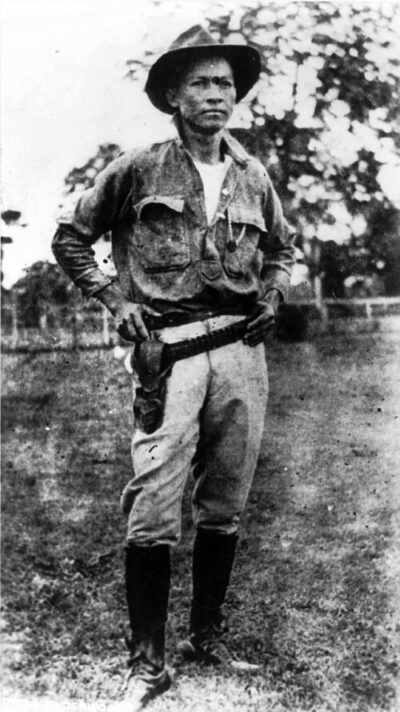
Augusto César Sandino
Augusto César Sandino was a Nicaraguan general, anti-imperialist revolutionary and national hero (1895–1934), born in Niquinohomo; EDSN founder who led resistance to U.S. occupation (1927–1933); assassinated in Managua by the National Guard on Somoza’s orders. Born May 18, 1895, in Niquinohomo. Died February 21, 1934, in Managua.
Facts
12 facts · 2 confirmed by two sources · 8 cited · 2 from one source
Where this comes from
Papalocal keeps its own record. It started from these sources; what each one said is kept here as it was copied, so a change on their side never changes this page by itself. Tap one to read its version.
What Wikidata says · copied November 16, 2026 · revision 2563520403
- Described as
- Nicaraguan general, anti-imperialist revolutionary and national hero (1895–1934), born in Niquinohomo; EDSN founder who led resistance to U.S. occupation (1927–1933); assassinated in Managua by the National Guard on Somoza’s orders
- Other names
- Sandino Augusto Sesar, Augusto Nicolás Calderón Sandino, Augusto C. Sandino, Sandino, Augusto Cesar Sandino
- Born
- May 18, 1895 · 4 references
- Died
- February 21, 1934 · 1 reference
- Born in
- Niquinohomo · 1 reference
- Died in
- Managua · 3 references
- Citizen of
- Nicaragua
- Occupation
- politician; military leader · 1 reference; revolutionary · 1 reference; artisan · 1 reference; soldier · 1 reference
- Spouse
- Blanca Aráuz (1927–1933) · 1 reference
- Military rank
- general · 2 references
- Wikipedias with a page
- 57
Wikidata item Q213746 (wikidata.org/wiki/Q213746), public domain (CC0). Copied November 16, 2026.
What Wikipedia says · copied November 16, 2026 · revision 1381706155
Augusto César Sandino (Latin American Spanish: [awˈɣusto 'sesar sanˈdino]; 18 May 1895 – 21 February 1934; Augusto Nicolás Calderón Sandino) was a Nicaraguan revolutionary, founder of the militant group EDSN, and leader of a rebellion between 1927 and 1933 against the United States occupation of Nicaragua. Despite being referred to as a bandit by the United States government, he has been considered a hero and a symbol of resistance to American imperialism throughout several regions of Latin America. Sandino drew units of the United States Marine Corps into an undeclared guerrilla war. The United States troops withdrew from the country in 1933 after overseeing the election and inauguration of President Juan Bautista Sacasa, who had returned from exile.
Sandino was executed in 1934 by National Guard forces of General Anastasio Somoza García, who went on to seize power in a coup d'état two years later. After being elected president by an overwhelming margin in 1936, Somoza García resumed control of the National Guard and established a dictatorship, with the Somoza family dynasty ruling Nicaragua for more than 40 years. Sandino's political legacy was claimed by the Sandinista National Liberation Front (FSLN), which overthrew the Somoza government in 1979 and then ensconced itself in power for more than 40 years.
Sandino is revered in Nicaragua and in 2010 its congress unanimously named him a "national hero". His political descendants, the icons of his wide-brimmed hat and boots, and his writings from the years of warfare against the USMC continue to shape Nicaragua's national identity.
- Born, in its opening lines
- May 18, 1895
- Died, in its opening lines
- February 21, 1934
From the Wikipedia article “Augusto César Sandino” (en.wikipedia.org/wiki/Augusto_César_Sandino), by its contributors, under CC BY-SA 4.0 (creativecommons.org/licenses/by-sa/4.0/). Copied November 16, 2026; not changed.
Confirmed Two sources agree. Cited One source, and it names where it got it. One source One source, without a reference of its own. Sources disagree The sources disagree. We show the best-supported value and keep theirs below.
