
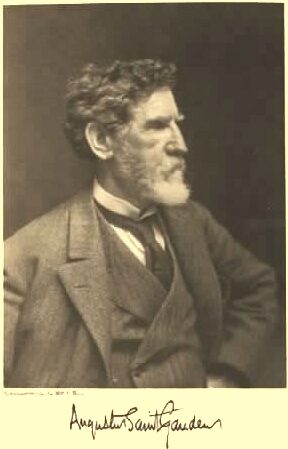
Augustus Saint-Gaudens
Augustus Saint-Gaudens was an American artist. Born March 1, 1848, in Dublin. Died August 3, 1907, in Cornish. Known for Abraham Lincoln: The Head of State, Diana and James Garfield Memorial, Philadelphia. Educated at Beaux-Arts de Paris and Cooper Union.
Facts
23 facts · 0 confirmed by two sources · 5 cited · 18 from one source
Where this comes from
Papalocal keeps its own record. It started from these sources; what each one said is kept here as it was copied, so a change on their side never changes this page by itself. Tap one to read its version.
What Wikidata says · copied November 16, 2026 · revision 2559604887
- Described as
- American artist (1848–1907)
- Other names
- Augustus Saint- Gaudens, st. gaudens, Augustus St. Gaudens
- Born
- March 1, 1848 · 14 references
- Died
- August 3, 1907 · 12 references
- Born in
- Dublin · 3 references
- Died in
- Cornish · 1 reference
- Cause of death
- cancer
- Citizen of
- United States
- Occupation
- sculptor · 1 reference
- Education
- Beaux-Arts de Paris; Cooper Union; National Academy of Design; Stanford University · 1 reference
- Member of
- American Academy of Arts and Letters; Royal Academy of Arts; American Academy of Arts and Sciences; International Society of Sculptors, Painters and Gravers; Salmagundi Club
- Known for
- Abraham Lincoln: The Head of State; Diana; James Garfield Memorial, Philadelphia
- Field
- art of sculpture · 1 reference
- Spouse
- Augusta Saint-Gaudens
- Children
- Homer Saint-Gaudens
- Siblings
- Louis Saint-Gaudens
- Wikipedias with a page
- 22
Wikidata item Q770625 (wikidata.org/wiki/Q770625), public domain (CC0). Copied November 16, 2026.
What Wikipedia says · copied November 16, 2026 · revision 1384675835
Augustus Saint-Gaudens () was an American sculptor and engraver of the Beaux-Arts generation who embodied the ideals of the American Renaissance.
Saint-Gaudens was born in Dublin to an Irish-French family, and raised in New York City. He traveled to Europe for further training and artistic study. After he returned to New York City, he achieved major critical success for his monuments commemorating heroes of the American Civil War, many of which still stand. Saint-Gaudens created works such as the Robert Gould Shaw Memorial on Boston Common, Abraham Lincoln: The Man, and grand equestrian monuments to Civil War generals: General John Logan Memorial in Chicago's Grant Park and William Tecumseh Sherman at the corner of New York's Central Park. In addition, he created the popular historicist representation of The Puritan.
Saint-Gaudens also created Classical works such as the Diana, and employed his design skills in numismatics. He designed the $20 Saint Gaudens Double Eagle gold coin (1905–1907) for the US Mint, considered one of the most beautiful American coins ever issued, and the $10 Indian Head eagle; both of these were minted from 1907 until 1933. In his later years he founded the "Cornish Colony", an artist's colony in New Hampshire that included notable painters, sculptors, writers, and architects. His brother Louis Saint-Gaudens, with whom he occasionally collaborated, was also a well-known sculptor.
From the Wikipedia article “Augustus Saint-Gaudens” (en.wikipedia.org/wiki/Augustus_Saint-Gaudens), by its contributors, under CC BY-SA 4.0 (creativecommons.org/licenses/by-sa/4.0/). Copied November 16, 2026; not changed.
Confirmed Two sources agree. Cited One source, and it names where it got it. One source One source, without a reference of its own. Sources disagree The sources disagree. We show the best-supported value and keep theirs below.
