
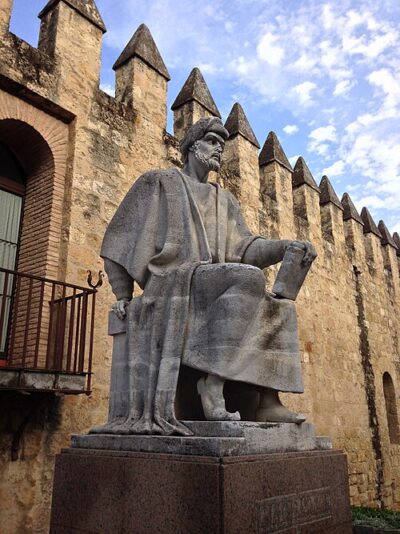
Averroes
Averroes was an Arab Andalusian Muslim writer and philosopher. Born April 14, 1126, in Córdoba. Died December 10, 1198, in Marrakech. Known for The Incoherence of the Incoherence, On the Harmony of Religions and Philosophy and Bidayat al-Mujtahid.
Facts
23 facts · 1 confirmed by two sources · 8 cited · 13 from one source · 1 where the sources disagree
What’s different
- Died: we show December 10, 1198 (Sources disagree). Wikipedia says December 11, 1198
Where this comes from
Papalocal keeps its own record. It started from these sources; what each one said is kept here as it was copied, so a change on their side never changes this page by itself. Tap one to read its version.
What Wikidata says · copied November 16, 2026 · revision 2564834119
- Described as
- Arab Andalusian Muslim writer and philosopher (1126–1198)
- Other names
- Averrhoes, Abū l-Walīd Muḥammad Ibn ʾAḥmad Ibn Rušd, Averroës, Averrhoës, Ibn Rushd
- Born
- April 14, 1126 · 2 references
- Died
- December 10, 1198 · 2 references
- Born in
- Córdoba · 3 references
- Died in
- Marrakech · 3 references
- Name at birth
- أبو الوليد محمد بن أحمد بن محمد بن رشد
- Occupation
- philosopher · 3 references; physician · 2 references; astronomer; judge · 1 reference; teacher; writer · 2 references; interpreter · 1 reference
- Known for
- The Incoherence of the Incoherence; On the Harmony of Religions and Philosophy; Bidayat al-Mujtahid; Colliget · 1 reference
- Field
- Islamic philosophy; astronomy; aqidah; fiqh; medicine; linguistics
- Religion
- Islam · 1 reference
- Wikipedias with a page
- 132
Wikidata item Q39837 (wikidata.org/wiki/Q39837), public domain (CC0). Copied November 16, 2026.
What Wikipedia says · copied November 16, 2026 · revision 1382265187
Ibn Rushd (14 April 1126 – 11 December 1198), Latinized as Averroes, was an Andalusian polymath and jurist who was proficient in a variety of intellectual fields, including philosophy, theology, medicine, astronomy, physics, psychology, mathematics, neurology, Islamic jurisprudence, law, and linguistics. The author of more than 100 books and treatises, his philosophical works include numerous commentaries on Aristotle, for which he was known in the Western world as "The Commentator" and "Father of Rationalism".
Averroes was a strong proponent of Aristotelianism; he attempted to restore what he considered the original teachings of Aristotle and opposed the Neoplatonist tendencies of earlier Muslim thinkers, such as al-Farabi and Avicenna. He also defended the pursuit of philosophy against criticism by Ash'ari theologians such as Al-Ghazali. Averroes argued that philosophy was permissible in Islam and even compulsory among certain elites. He also argued scriptural text should be interpreted allegorically if it appeared to contradict conclusions reached by reason and philosophy. In Islamic jurisprudence, he wrote the Bidāyat al-Mujtahid on the differences between Islamic schools of law and the principles that caused their differences. In medicine, he proposed a new theory of stroke, described the signs and symptoms of Parkinson's disease for the first time, and might have been the first to identify the retina as the part of the eye responsible for sensing light. His medical book Al-Kulliyat fi al-Tibb, translated into Latin and known as the Colliget, became a textbook in Europe for centuries.
His legacy in the Islamic world was modest for geographical and intellectual reasons. In the West, Averroes was known for his extensive commentaries on Aristotle, many of which were translated into Latin and Hebrew. The translations of his work reignited Western European interest in Aristotle and Greek thinkers, an area of study that had been widely abandoned after the fall of the Western Roman Empire. His thoughts generated controversies in Latin Christendom and triggered a philosophical movement called Averroism based on his writings. His unity of the intellect thesis, proposing that all humans share the same intellect, became one of the best-known and most controversial Averroist doctrines in the West. His works were condemned by the Catholic Church in 1270 and 1277. Although weakened by condemnations and sustained critique from Thomas Aquinas, Latin Averroism continued to attract followers up to the sixteenth century.
- Born, in its opening lines
- April 14, 1126
- Died, in its opening lines
- December 11, 1198
From the Wikipedia article “Averroes” (en.wikipedia.org/wiki/Averroes), by its contributors, under CC BY-SA 4.0 (creativecommons.org/licenses/by-sa/4.0/). Copied November 16, 2026; not changed.
Confirmed Two sources agree. Cited One source, and it names where it got it. One source One source, without a reference of its own. Sources disagree The sources disagree. We show the best-supported value and keep theirs below.
