
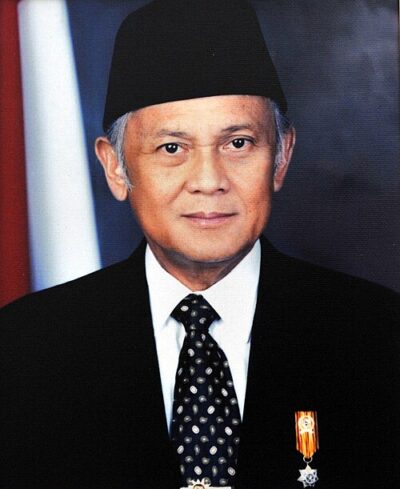
B. J. Habibie
B. J. Habibie was the 3rd President of Indonesia (1998—1999) and 7th Vice President of Indonesia. Born June 25, 1936, in Parepare. Died September 11, 2019, in Gatot Soebroto Army Hospital. Positions held include President of Indonesia (1998–1999) and Vice President of Indonesia (1998). Educated at Bandung Institute of Technology and RWTH Aachen University. Awards include Edward Warner Award, Bintang Bhayangkara Utama and Bintang Swa Bhuwana Paksa Utama.
Facts
40 facts · 2 confirmed by two sources · 8 cited · 30 from one source
Where this comes from
Papalocal keeps its own record. It started from these sources; what each one said is kept here as it was copied, so a change on their side never changes this page by itself. Tap one to read its version.
What Wikidata says · copied November 16, 2026 · revision 2564124627
- Described as
- 3rd President of Indonesia (1998—1999) and 7th Vice President of Indonesia (1998)
- Other names
- Bacharuddin Jusuf Habibie
- Born
- June 25, 1936 · 6 references
- Died
- September 11, 2019 · 4 references
- Born in
- Parepare · 1 reference
- Died in
- Gatot Soebroto Army Hospital · 1 reference
- Buried in
- Kalibata Heroes Cemetery · 1 reference
- Cause of death
- heart failure
- Name at birth
- Bacharuddin Jusuf Habibie
- Citizen of
- Indonesia
- Occupation
- politician · 2 references; engineer
- Positions held
- President of Indonesia (1998–1999); Vice President of Indonesia (1998)
- Political party
- Golkar
- Education
- Bandung Institute of Technology (–1954); RWTH Aachen University (–1962) · 1 reference
- Member of
- National Academy of Engineering · 1 reference
- Awards
- Edward Warner Award (1994) · 1 reference; Bintang Bhayangkara Utama (1998); Bintang Swa Bhuwana Paksa Utama (1998); Star of Jalasena (1998); Star of the Kartika Eka Pakçi (1998); Bintang Yudha Dharma (1998); Cultural Merit Star (1998); Bintang Jasa Utama (1998); Bintang Mahaputera Adipradana (1982); Bintang Mahaputera Adipurna (1998); Star of the Republic of Indonesia, 2nd class (1998); Star of the Republic of Indonesia, First class (1998); Order of Merit of the Federal Republic of Germany; Order of Orange-Nassau (1983); Grand Cross of the Order of Civil Merit (1987)
- Spouse
- Hasri Ainun Habibie (1962–)
- Children
- Ilham Akbar Habibie; Thareq Kemal Habibie
- Father
- Alwi Abdul Jalil Habibie
- Mother
- Tuti Marini Puspowardojo
- Siblings
- Junus Effendi Habibie
- Religion
- Islam
- Height
- 1.62 m (5 ft 4 in) · 1 reference
- Website
- http://www.habibiecenter.or.id/
- Wikipedias with a page
- 81
Wikidata item Q76156 (wikidata.org/wiki/Q76156), public domain (CC0). Copied November 16, 2026.
What Wikipedia says · copied November 16, 2026 · revision 1380167413
Bacharuddin Jusuf Habibie (Indonesian: [bahaˌrudin ˌjusuf haˈbibi] ; 25 June 1936 – 11 September 2019) was an Indonesian statesman, engineer, scientist and inventor who served as the third president of Indonesia from 1998 to 1999. A little over two months after his inauguration as the seventh vice president in March 1998, he succeeded Suharto, who resigned after 32 years in office, thereby being the country's first vice president to assume the presidency intra-term. Originating from Sulawesi with Bugis-Gorontalese and Javanese ancestry, his presidency was seen as a landmark and transition to the Reform era.
Upon becoming president, he liberalized Indonesia's press and political party laws; ended Indonesian occupation of East Timor, which led to that country's independence; and held an early democratic election three years sooner than scheduled, which resulted in the end of his presidency. His 517-day presidency and 71-day vice-presidency were each the shortest in Indonesian history. Before entering government, Habibie contributed to the making of Indonesia's first domestic airplane, the IPTN N-250. As a result, he was granted the title "Father of Technology".
- Born, in its opening lines
- June 25, 1936
- Died, in its opening lines
- September 11, 2019
From the Wikipedia article “B. J. Habibie” (en.wikipedia.org/wiki/B._J._Habibie), by its contributors, under CC BY-SA 4.0 (creativecommons.org/licenses/by-sa/4.0/). Copied November 16, 2026; not changed.
Confirmed Two sources agree. Cited One source, and it names where it got it. One source One source, without a reference of its own. Sources disagree The sources disagree. We show the best-supported value and keep theirs below.
