
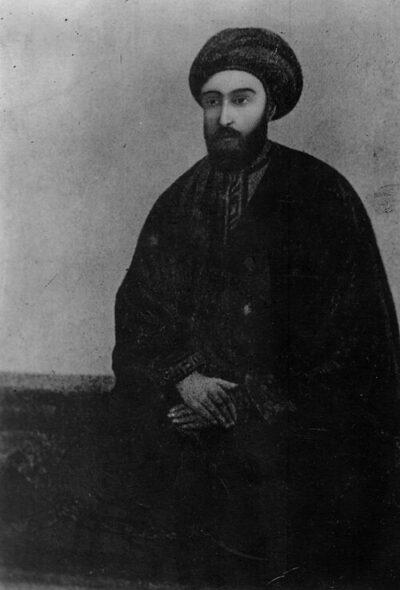
Báb
Báb was a founder of Bábism and, according to the Baháʼís, predecessor of Baháʼu'lláh. Born October 20, 1819, in Shiraz. Died July 9, 1850, in Tabriz.
Facts
17 facts · 2 confirmed by two sources · 1 cited · 14 from one source
Where this comes from
Papalocal keeps its own record. It started from these sources; what each one said is kept here as it was copied, so a change on their side never changes this page by itself. Tap one to read its version.
What Wikidata says · copied November 16, 2026 · revision 2567475185
- Described as
- founder of Bábism and, according to the Baháʼís, predecessor of Baháʼu'lláh
- Other names
- Bab, Nuqtah-i Ula, Ali Mukhamed Bab, Ali Muhammad ibn Rida al-Bazzazz, Ali Muhammad Rida al-Shirazi, the Báb, the Bab, ʻAlí-Muḥammad
- Born
- October 20, 1819 · 5 references
- Died
- July 9, 1850 · 6 references
- Born in
- Shiraz · 1 reference
- Died in
- Tabriz · 1 reference
- Buried in
- Shrine of the Báb
- Cause of death
- gunshot wound
- Name at birth
- عَلیمُحَمَّد شیرازی
- Citizen of
- Qajar Iran
- Occupation
- religious leader · 1 reference; preacher; merchant; orator; poet; writer; founder of religion
- Spouse
- Khadíjih-Bagum (1842–1850)
- Religion
- Bábism · 1 reference
- Wikipedias with a page
- 81
Wikidata item Q104273 (wikidata.org/wiki/Q104273), public domain (CC0). Copied November 16, 2026.
What Wikipedia says · copied November 16, 2026 · revision 1385830814
The Báb (born ʻAlí-Muḥammad Shírází; ; Persian: علیمحمد شیرازی; 20 October 1819 – 9 July 1850) was an Iranian religious leader who founded Bábism, and is also one of the central figures of the Baháʼí Faith. The Báb gradually and progressively revealed his claim in his extensive writings to be a Manifestation of God, of a status as great as Moses, Jesus, and Prophet Muhammad, receiving revelations as profound as the Torah, Gospel, and Quran. This new revelation, he claimed, would release the creative energies and capacities necessary for the establishment of global unity and peace.
He referred to himself by the traditional Muslim title "Báb" (meaning "the gate") although it was apparent from the context that he intended by this term a spiritual claim very different from any which had previously been associated with it. He proclaimed that the central purpose of his mission was to prepare for the coming of a spiritual luminary greater than himself — the promised one of the world's great religions; he referred to this promised deliverer as "he whom God will make manifest". The Báb was the "gateway" to this messianic figure, whose message would be carried throughout the world.
The Báb was born in Shiraz on 20 October 1819, to a family of sayyids of Husaynid lineage, most of whom were engaged in mercantile activities in Shiraz and Bushehr. He was a merchant from Shiraz in Qajar Iran who, in 1844 at the age of 25, began the Bábi Faith. In the next six years, the Báb composed numerous letters and books in which he abrogated Islamic laws and traditions, establishing a new religion and introducing a new social order focused on unity, love, and service to others. He encouraged the learning of arts and sciences, modernizing education, and improving the status of women. He introduced the concept of progressive revelation, highlighting the continuity and renewal of religion. He also emphasized ethics, independent investigation of truth, and human nobility. Additionally, he provided prescriptions to regulate marriage, divorce, and inheritance, and set forth rules for a future Bábí society, although these were never implemented. Throughout, the Báb always discussed his own revelation and laws in the context of the aforementioned promised figure. Unlike previous religions, which sporadically alluded to promised figures, the primary focus of the Bayán, the foundational text of the Bábí faith, was to prepare for the arrival of the promised one. The Báb was popular among the lower classes, the poor and the urban merchants, artisans, and some villagers. However, he faced opposition from the orthodox clergy and the government, which eventually executed him and thousands of his followers, who were known as Bábís.
When the Báb was executed for apostasy, he was tied up in a public square in Tabriz and faced a firing squad. Following the first volley, the Báb was discovered to be missing and later found and returned to the square. He was eventually killed by the second volley. Accounts differ on the details, but all agree that the first volley failed to kill him. This widely documented event increased interest in his message. His remains were secretly stored and transported until they were interred in 1909 into the shrine built for them by ʻAbdu'l-Bahá on the slopes of Mount Carmel.
To Baháʼís, the Báb fills a similar role as Elijah in Judaism or John the Baptist in Christianity: a forerunner or founder of their own religion. Adherence to the Báb as a divine messenger has survived into modern times in the form of the 8-million-member Baháʼí Faith, whose founder, Baháʼu'lláh, claimed in 1863 to be the fulfillment of the Báb's prophecy. The majority of Bábí adherents converted and became Baháʼís by the end of the 19th century. The Baháʼís consider him a Manifestation of God, like Adam, Abraham, Moses, Zoroaster, Krishna, the Buddha, Jesus, Prophet Muhammad and Baháʼu'lláh.
- Born, in its opening lines
- October 20, 1819
- Died, in its opening lines
- July 9, 1850
From the Wikipedia article “Báb” (en.wikipedia.org/wiki/Báb), by its contributors, under CC BY-SA 4.0 (creativecommons.org/licenses/by-sa/4.0/). Copied November 16, 2026; not changed.
Confirmed Two sources agree. Cited One source, and it names where it got it. One source One source, without a reference of its own. Sources disagree The sources disagree. We show the best-supported value and keep theirs below.
