
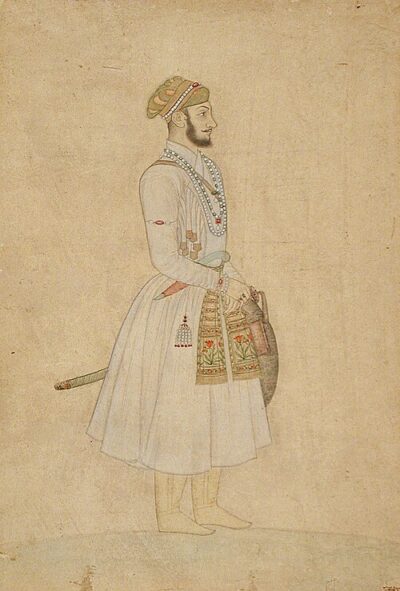
Bahadur Shah I
Bahadur Shah I was the seventh Mughal Emperor from 1707 to 1712. Born October 14, 1643, in Burhanpur. Died February 27, 1712, in Lahore. Positions held include Mughal emperor (1707–1712).
Facts
28 facts · 2 confirmed by two sources · 0 cited · 25 from one source · 1 where the sources disagree
What’s different
- Buried in: we show Tomb complex at Mehrauli Dargah (Sources disagree). Wikidata also lists Moti Masjid
Where this comes from
Papalocal keeps its own record. It started from these sources; what each one said is kept here as it was copied, so a change on their side never changes this page by itself. Tap one to read its version.
What Wikidata says · copied November 16, 2026 · revision 2545329066
- Described as
- the seventh Mughal Emperor from 1707 to 1712
- Other names
- Bahadur Shah
- Born
- October 14, 1643 · 1 reference
- Died
- February 27, 1712 · 1 reference
- Born in
- Burhanpur
- Died in
- Lahore
- Buried in
- Tomb complex at Mehrauli Dargah; Moti Masjid
- Occupation
- monarch
- Positions held
- Mughal emperor (1707–1712)
- Spouse
- Nizam Bai; Maharajkumari Amrita Bai Sahiba; Nur un-nisa Begum · 1 reference; Nur-un-nissa Begum
- Children
- Jahandar Shah; Azz-ud-din; Azim-ush-Shan; Rafi-ush-Shan; Jahan Shah
- Father
- Aurangzeb
- Mother
- Nawab Bai
- Siblings
- Badr-un-Nissa Begum; Zinat un-nisa; Zubdat-un-Nissa; Zeb-un-Nisa; Mehr-un-Nissa; Sultan Muhammad Akbar; Azam Shah; Kam Bakhsh; Muhammad Sultan of Mughal
- Religion
- Islam
- Wikipedias with a page
- 50
Wikidata item Q544228 (wikidata.org/wiki/Q544228), public domain (CC0). Copied November 16, 2026.
What Wikipedia says · copied November 16, 2026 · revision 1379479246
Bahadur Shah I (Muhammad Mu'azzam; 14 October 1643 – 27 February 1712) or Shah Alam I, was the eighth Mughal emperor from 1707 to 1712. He was the second son of the sixth Mughal emperor Aurangzeb, who he conspired to overthrow in his youth. He was also the governor of the imperial provinces of Agra, Kabul and Lahore and had to face revolts of Rajputs and Sikhs.
After Aurangzeb's death, Muhammad Azam Shah, his third son by his chief consort Dilras Banu Begum declared himself successor, but was shortly defeated in one of the largest battles of India, the Battle of Jajau and overthrown by Bahadur Shah. During the reign of Bahadur Shah, the Rajput kingdoms of Jodhpur and Amber were re-annexed after they had declared independence a few years prior.
Bahadur Shah also sparked an Islamic controversy in the khutba by inserting the declaration of Ali as wasi. His reign was disturbed by several rebellions, the Sikhs under the leadership of Banda Singh Bahadur, Rajputs under Durgadas Rathore and a Mughal prince and Bahadur Shah's half-brother Kam Bakhsh but all of them were successfully quelled.
- Born, in its opening lines
- October 14, 1643
- Died, in its opening lines
- February 27, 1712
From the Wikipedia article “Bahadur Shah I” (en.wikipedia.org/wiki/Bahadur_Shah_I), by its contributors, under CC BY-SA 4.0 (creativecommons.org/licenses/by-sa/4.0/). Copied November 16, 2026; not changed.
Confirmed Two sources agree. Cited One source, and it names where it got it. One source One source, without a reference of its own. Sources disagree The sources disagree. We show the best-supported value and keep theirs below.
