
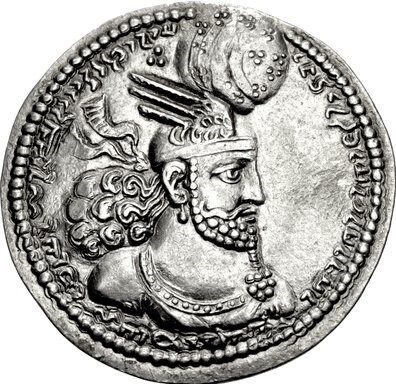
Bahram II
Bahram II was a fifth Sasanian emperor. Born 3rd century. Died 293. Positions held include emperor of the Sasanian Empire (274–293).
Facts
12 facts · 0 confirmed by two sources · 0 cited · 10 from one source · 2 where the sources disagree
What’s different
- Born: we show 3rd century (Sources disagree). Wikipedia says 271
- Died: we show 293 (Sources disagree). Wikipedia says 274
Where this comes from
Papalocal keeps its own record. It started from these sources; what each one said is kept here as it was copied, so a change on their side never changes this page by itself. Tap one to read its version.
What Wikidata says · copied November 16, 2026 · revision 2553933850
- Described as
- fifth Sasanian emperor (274–293)
- Other names
- Wahram II, Vahram II
- Born
- 3rd century
- Died
- 293
- Buried in
- Naqsh-e Rustam
- Citizen of
- Sasanian Empire
- Occupation
- monarch
- Positions held
- emperor of the Sasanian Empire (274–293)
- Spouse
- Shapurdukhtak; Qandīdā
- Children
- Bahram III
- Father
- Bahram I
- Siblings
- Hormizd I Kushanshah
- Religion
- Zoroastrianism
- Wikipedias with a page
- 42
Wikidata item Q299255 (wikidata.org/wiki/Q299255), public domain (CC0). Copied November 16, 2026.
What Wikipedia says · copied November 16, 2026 · revision 1370250308
Bahram II (also spelled Wahram II or Warahran II; Middle Persian: 𐭥𐭫𐭧𐭫𐭠𐭭) was the fifth Sasanian King of Kings (shahanshah) of Iran, from 274 to 293. He was the son and successor of Bahram I (r. 271–274). Bahram II, while still in his teens, ascended the throne with the aid of the powerful Zoroastrian priest Kartir, just like his father had done.
He was met with considerable challenges during his reign, facing a rebellion in the east led by his brother, the Kushano-Sasanian dynast Hormizd I Kushanshah, who also assumed the title of King of Kings and possibly laid claims to the Sasanian throne. Another rebellion, led by Bahram II's cousin Hormizd of Sakastan in Sakastan, also occurred around this period. In Khuzestan, a Zoroastrian factional revolt led by a high-priest (mowbed) occurred. The Roman emperor Carus exploited the turbulent situation of Iran by launching a campaign into its holdings in Mesopotamia in 283. Bahram II, who was in the east, was unable to mount an effective coordinated defense at the time, possibly losing his capital of Ctesiphon to the Roman emperor. However, Carus died soon afterwards, reportedly being struck by lightning. As a result, the Roman army withdrew, and Mesopotamia was reclaimed by the Sasanians. By the end of his reign, Bahram II had made peace with the Roman emperor Diocletian and put an end to the disturbances in Khuzestan and the east.
In the Caucasus, Bahram II strengthened Sasanian authority by securing the Iberian throne for Mirian III, an Iranian nobleman from the House of Mihran. Bahram II has been suggested by scholars to be the first Sasanian ruler to have coins minted of his family. He also ordered the carving of several rock reliefs that emphasize distinguished representations of his family and members of the high nobility. He was succeeded by his son Bahram III, who after only four months of reign, was overthrown by Narseh, a son of the second Sasanian ruler, Shapur I (r. 240–270).
- Born, in its opening lines
- 271
- Died, in its opening lines
- 274
From the Wikipedia article “Bahram II” (en.wikipedia.org/wiki/Bahram_II), by its contributors, under CC BY-SA 4.0 (creativecommons.org/licenses/by-sa/4.0/). Copied November 16, 2026; not changed.
Confirmed Two sources agree. Cited One source, and it names where it got it. One source One source, without a reference of its own. Sources disagree The sources disagree. We show the best-supported value and keep theirs below.
