
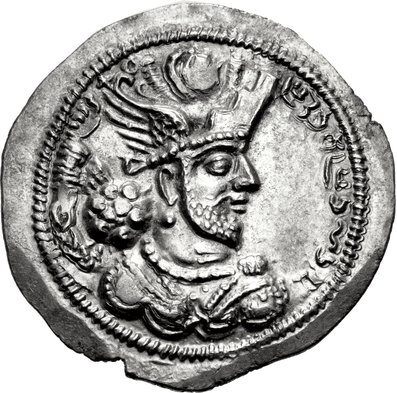
Bahram IV
Bahram IV was The 13th Sassanid Emperor. Born 4th century. Died 399. Positions held include emperor of the Sasanian Empire (388–399).
Facts
9 facts · 0 confirmed by two sources · 0 cited · 7 from one source · 2 where the sources disagree
What’s different
- Born: we show 4th century (Sources disagree). Wikipedia says 383
- Died: we show 399 (Sources disagree). Wikipedia says 388
Where this comes from
Papalocal keeps its own record. It started from these sources; what each one said is kept here as it was copied, so a change on their side never changes this page by itself. Tap one to read its version.
What Wikidata says · copied November 16, 2026 · revision 2553936279
- Described as
- The 13th Sassanid Emperor (388–399)
- Other names
- Wahram IV, Vahram IV, Warahran IV;
- Born
- 4th century
- Died
- 399
- Citizen of
- Sasanian Empire
- Occupation
- monarch
- Positions held
- emperor of the Sasanian Empire (388–399)
- Children
- Khosrau the Usurper · 1 reference
- Father
- Shapur III
- Siblings
- Yazdegerd I
- Religion
- Zoroastrianism
- Wikipedias with a page
- 37
Wikidata item Q313644 (wikidata.org/wiki/Q313644), public domain (CC0). Copied November 16, 2026.
What Wikipedia says · copied November 16, 2026 · revision 1371114705
Bahram IV (also spelled Wahram IV or Warahran IV; Middle Persian: 𐭥𐭫𐭧𐭫𐭠𐭭), was the Sasanian King of Kings (shahanshah) of Iran from 388 to 399. He was likely the son and successor of Shapur III (r. 383–388).
Before his accession to the throne, Bahram served as governor of the southeastern province of Kirman. There he bore the title of Kirmanshah (meaning "king of Kirman"), which would serve as the name city he later founded in western Iran.
His reign as shahanshah was largely uneventful. In Armenia, he deposed his insubordinate vassal Khosrov IV and installed his brother Vramshapuh on the Armenian throne. In 395, the Huns invaded the countryside around the Euphrates and the Tigris, but were repelled. It was under Bahram IV that the use of mint signatures became regular, with several new mints established in his empire. Like his father, Bahram IV was killed by the nobility; he was succeeded by his brother Yazdegerd I.
He is notable for being portrayed on two seals, one during his tenure as Kirmanshah; and the other as shahanshah.
- Born, in its opening lines
- 383
- Died, in its opening lines
- 388
From the Wikipedia article “Bahram IV” (en.wikipedia.org/wiki/Bahram_IV), by its contributors, under CC BY-SA 4.0 (creativecommons.org/licenses/by-sa/4.0/). Copied November 16, 2026; not changed.
Confirmed Two sources agree. Cited One source, and it names where it got it. One source One source, without a reference of its own. Sources disagree The sources disagree. We show the best-supported value and keep theirs below.
