
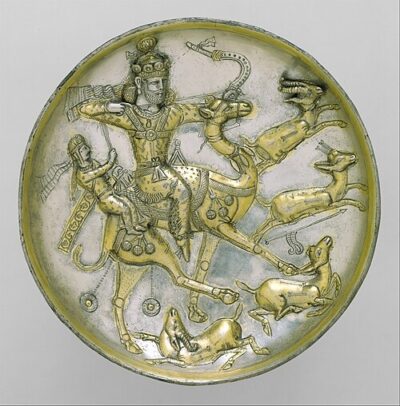
Bahram V
Bahram V was The 15th Sassanid Emperor. Born 406. Died 438, in Media. Positions held include emperor of the Sasanian Empire (420–438).
Facts
13 facts · 0 confirmed by two sources · 3 cited · 8 from one source · 2 where the sources disagree
What’s different
- Born: we show 406 (Sources disagree). Wikipedia says 399
- Died: we show 438 (Sources disagree). Wikidata also lists 439
Where this comes from
Papalocal keeps its own record. It started from these sources; what each one said is kept here as it was copied, so a change on their side never changes this page by itself. Tap one to read its version.
What Wikidata says · copied November 16, 2026 · revision 2553933771
- Described as
- The 15th Sassanid Emperor (421–438)
- Other names
- Bahram Gor, Bahram Gur
- Born
- 406
- Died
- 438 · 1 reference; 439 · 1 reference
- Died in
- Media
- Citizen of
- Sasanian Empire
- Occupation
- sovereign; monarch
- Positions held
- emperor of the Sasanian Empire (420–438) · 1 reference
- Spouse
- Sepinud · 1 reference
- Children
- Yazdegerd II
- Father
- Yazdegerd I · 1 reference
- Mother
- Shushandukht
- Siblings
- Shapur IV
- Religion
- Zoroastrianism
- Wikipedias with a page
- 51
Wikidata item Q299271 (wikidata.org/wiki/Q299271), public domain (CC0). Copied November 16, 2026.
What Wikipedia says · copied November 16, 2026 · revision 1368355853
Bahram V (also spelled Wahram V or Warahran V; Middle Persian: 𐭥𐭫𐭧𐭫𐭠𐭭), also known as Bahram Gur (New Persian: بهرام گور, "Bahram the onager [hunter]"), was the Sasanian King of Kings (shahanshah) from 420 to 438.
The son of the incumbent Sasanian shah Yazdegerd I (r. 399–420), Bahram was at an early age sent to the Lahkmid court in al-Hira, where he was raised under the tutelage of the Lakhmid kings. After the assassination of his father, Bahram hurried to the Sasanian capital of Ctesiphon with a Lakhmid army, and won the favour of the nobles and priests, according to a long-existing popular legend, after withstanding a trial against two lions.
Bahram V's reign was generally peaceful, with two brief wars—first against his western neighbours, the Eastern Roman Empire, and then against his eastern neighbours, the Kidarites, who were disturbing the Sasanian eastern provinces. It was also during his reign that the Arsacid line of Armenia was replaced by a marzban (governor of a frontier province, "margrave"), which marked the start of a new era in Armenia, known in Armenian historiography as the "Marzpanate period".
Bahram V is a central figure in several of the most famous works in Persian literature. He is mentioned in Ferdowsi's Shahnameh ("Book of Kings") written between 977 and 1010, and he is the protagonist of Nizami Ganjavi's romantic epic Haft Peykar (also known as the "Bahramnameh"), written in 1197. The Seven Beauties were princesses, which—in Nizami's imagination—became Bahram's wives and each received her own residence in his palace. He visited them on a rotating basis, and they entertained him with exciting stories. He is also the focal point in the Hasht-Behesht ("Eight Paradises"), written by Amir Khusrau in ca. 1302.
Bahram V is remembered as one of the most famous kings in Iranian history, due to his cancellation of taxes and public debt at celebratory events, his encouragement of musicians, and his enjoyment of hunting. He was succeeded by his son Yazdegerd II (r. 438–457).
- Born, in its opening lines
- 399
- Died, in its opening lines
- 420
From the Wikipedia article “Bahram V” (en.wikipedia.org/wiki/Bahram_V), by its contributors, under CC BY-SA 4.0 (creativecommons.org/licenses/by-sa/4.0/). Copied November 16, 2026; not changed.
Confirmed Two sources agree. Cited One source, and it names where it got it. One source One source, without a reference of its own. Sources disagree The sources disagree. We show the best-supported value and keep theirs below.
