
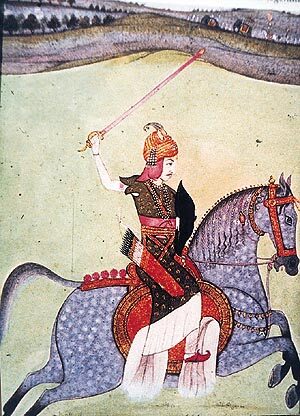
Baji Rao I
Baji Rao I was a General of the Maratha Empire in India. Born August 18, 1700, in Sinnar. Died April 28, 1740. Positions held include Peshwa (1720–1740).
Facts
14 facts · 2 confirmed by two sources · 0 cited · 12 from one source
Where this comes from
Papalocal keeps its own record. It started from these sources; what each one said is kept here as it was copied, so a change on their side never changes this page by itself. Tap one to read its version.
What Wikidata says · copied November 16, 2026 · revision 2554223013
- Described as
- General of the Maratha Empire in India (1700-1740)
- Other names
- Bajirao I, Bajirao Ballal Bhat
- Born
- August 18, 1700
- Died
- April 28, 1740
- Born in
- Sinnar · 1 reference
- Citizen of
- Maratha Empire · 1 reference
- Positions held
- Peshwa (1720–1740)
- Spouse
- Mastani; Kashibai
- Children
- Shamsher Bahadur I; Balaji Baji Rao; Raghunathrao
- Father
- Balaji Vishwanath
- Siblings
- Chimaji Appa
- Religion
- Hinduism
- Military rank
- general
- Wikipedias with a page
- 40
Wikidata item Q2514706 (wikidata.org/wiki/Q2514706), public domain (CC0). Copied November 16, 2026.
What Wikipedia says · copied November 16, 2026 · revision 1385907673
Bajirao I (born Visaji, Marathi: [ˈbaːdʑiɾaːʋ bəˈlːaːɭ̆]; 18 August 1700 – 28 April 1740) was the 7th Peshwa of the Maratha Empire.
Born in a Brahmin family as the son of Peshwa Balaji Vishwanath, he began his military career at a young age. After the death of Balaji, he was proclaimed Peshwa and over the new two decades he led the Maratha army on an unprecedented campaign of expansion, conquering Mughal territory up till Delhi and Cuttack. He further solidified Maratha authority in the Deccan by defeating the Nizam of Hyderabad at Palkhed and liberated several kingdoms and vassals from Mughal influence. Among them was the Bundela ruler Chhatrasal, whom Bajirao rescued from a Mughal siege, gaining independence for Bundelkhand. Subsequently, Chhatrasal granted Bajirao a jagir and his daughter Mastani's hand in marriage. Bajirao asserted Maratha tax rights in Gujarat, defeating rebel Trimbak Rao Dabhade in 1731 at Dabhoi; he also engaged in a diplomatic mission to persuade Rajput courts for chauth payments. Further efforts to establish Maratha dominance saw him responsible for the Battle of Delhi (1737) which may be said to mark the pinnacle of his military career. He secured the important territory of Malwa after defeating the combined forces of Mughal-Nizam-Nawab of Awadh in Battle of Bhopal (1737). At the time of his death in 1740, the Maratha Empire had reached its greatest territorial extent yet and was amongst the largest powers of the subcontinent.
Bajirao's adventurous life has been picturized in Indian cinema and also featured in novels. Bajirao had two wives: Kashibai and Mastani. Bajirao's relationship with his second wife Mastani is a controversial subject; very little is known with certainty about it. She was generally referenced cryptically in books, letters or documents from that era.
- Born, in its opening lines
- August 18, 1700
- Died, in its opening lines
- April 28, 1740
From the Wikipedia article “Bajirao I” (en.wikipedia.org/wiki/Bajirao_I), by its contributors, under CC BY-SA 4.0 (creativecommons.org/licenses/by-sa/4.0/). Copied November 16, 2026; not changed.
Confirmed Two sources agree. Cited One source, and it names where it got it. One source One source, without a reference of its own. Sources disagree The sources disagree. We show the best-supported value and keep theirs below.
