
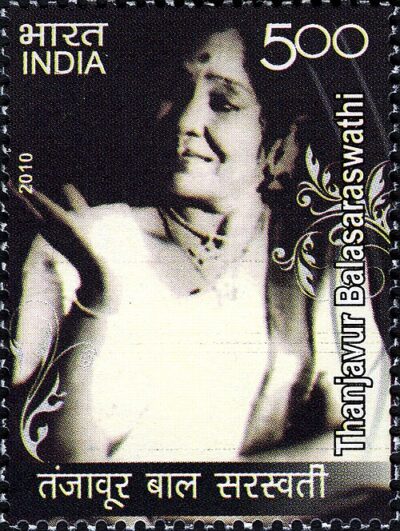
Balasaraswati
Balasaraswati was an Indian dancer. Born May 13, 1918, in Chennai. Died February 9, 1984, in Chennai. Awards include Sangeet Natak Akademi Award, Padma Bhushan in Art and Padma Vibhushan.
Facts
12 facts · 2 confirmed by two sources · 3 cited · 7 from one source
Where this comes from
Papalocal keeps its own record. It started from these sources; what each one said is kept here as it was copied, so a change on their side never changes this page by itself. Tap one to read its version.
What Wikidata says · copied November 18, 2026 · revision 2568893474
- Described as
- Indian dancer (1918-1984)
- Other names
- Tanjore Balasaraswati
- Born
- May 13, 1918 · 2 references
- Died
- February 9, 1984 · 2 references
- Born in
- Chennai · 1 reference
- Died in
- Chennai · 1 reference
- Citizen of
- British Raj (–1947); India (1950–)
- Occupation
- dancer · 1 reference
- Genre
- Carnatic music
- Awards
- Sangeet Natak Akademi Award (1955) · 1 reference; Padma Bhushan in Art (1957); Padma Vibhushan
- Children
- Lakshmi Knight
- Wikipedias with a page
- 23
Wikidata item Q3522332 (wikidata.org/wiki/Q3522332), public domain (CC0). Copied November 18, 2026.
What Wikipedia says · copied November 18, 2026 · revision 1379863336
Tanjore Balasaraswati, also known as Balasaraswati (13 May 1918 – 9 February 1984), was an Indian dancer, and her rendering of Bharatanatyam, a classical dance style that originated in the South Indian state of Tamil Nadu, made this style of dancing well known in different parts of India and around the world. Belonging to the devadasi lineage, she preserved the traditional form of Bharatanatyam that embraced shringara (erotic depictions of divine love), viewing it as beautiful and spiritual rather than immoral, unlike dancers such as Rukmini Devi Arundale, who sought to reform the dance by removing its erotic elements.
She was awarded the Padma Bhushan in 1957 and the Padma Vibhushan in 1977, the third and the second highest civilian honours given by the Government of India. In 1973, Sangeet Natak Akademi Fellowship, the highest award of Sangeet Natak Akademi, India's National Academy of Music and Performing Arts in 1975 She was awarded the Sangeetha Kalanidhi by the Madras Music Academy. In 1981, she was awarded the Sangeetha Kalasikhamani award by the Indian Fine Arts Society, Chennai.
- Born, in its opening lines
- May 13, 1918
- Died, in its opening lines
- February 9, 1984
From the Wikipedia article “Balasaraswati” (en.wikipedia.org/wiki/Balasaraswati), by its contributors, under CC BY-SA 4.0 (creativecommons.org/licenses/by-sa/4.0/). Copied November 18, 2026; not changed.
Confirmed Two sources agree. Cited One source, and it names where it got it. One source One source, without a reference of its own. Sources disagree The sources disagree. We show the best-supported value and keep theirs below.
