
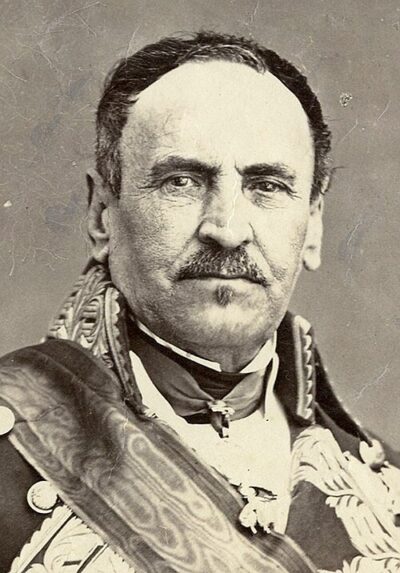
Baldomero Espartero, Prince of Vergara
Baldomero Espartero, Prince of Vergara was a Spanish general and noble. Born February 27, 1793, in Granátula de Calatrava. Died January 8, 1879, in Logroño. Positions held include member of the Cortes during the reign of Isabel II (2 times) (1836–1856), ministro de la Guerra (1837–1838) and viceroy of Navarra (1839–1840). Awards include Knight of the Order of the Golden Fleece and Grand Cross of the Order of Isabella the Catholic.
Facts
30 facts · 2 confirmed by two sources · 6 cited · 22 from one source
Where this comes from
Papalocal keeps its own record. It started from these sources; what each one said is kept here as it was copied, so a change on their side never changes this page by itself. Tap one to read its version.
What Wikidata says · copied November 16, 2026 · revision 2567550012
- Described as
- Spanish general and noble (1793-1879)
- Other names
- Baldomero Espartero, Espartero, Joaquín Baldomero Fernández-Espartero y Álvarez de Toro
- Born
- February 27, 1793 · 5 references
- Died
- January 8, 1879 · 7 references
- Born in
- Granátula de Calatrava
- Died in
- Logroño · 1 reference
- Buried in
- Co-cathedral of Santa María de la Redonda
- Name at birth
- Joaquín Baldomero Fernández-Espartero y Álvarez de Toro
- Citizen of
- Spain
- Occupation
- politician · 2 references; military personnel; regent; soldier · 1 reference
- Positions held
- member of the Cortes during the reign of Isabel II (2 times) (1836–1856); ministro de la Guerra (1837–1838); viceroy of Navarra (1839–1840); President of the Council of Ministers (3 times) (1837–1856); Regent of Spain (1840–1843); Member of the Congress during Sexenio Democrático (1869); President of the Congress of Deputies (1854)
- Political party
- Progressive Party
- Member of
- Congress of Deputies; Real Academia de Nobles y Bellas Artes de San Luis
- Awards
- Knight of the Order of the Golden Fleece; Grand Cross of the Order of Isabella the Catholic
- Field
- military affairs · 1 reference; politics · 1 reference
- Spouse
- María Jacinta Martínez de Sicilia y Santa Cruz (1827–1878)
- Siblings
- Francisco Fernández-Espartero y Álvarez de Toro
- Military rank
- Captain general of the Army; general · 1 reference
- Lived in
- Logroño
- Wikipedias with a page
- 32
Wikidata item Q434529 (wikidata.org/wiki/Q434529), public domain (CC0). Copied November 16, 2026.
What Wikipedia says · copied November 16, 2026 · revision 1364634905
Baldomero Fernández-Espartero y Álvarez de Toro (27 February 1793 – 8 January 1879) was a Spanish captain general and statesman. He served as the Regent of the Realm, three times as Prime Minister and briefly as President of the Congress of Deputies. Throughout his life, he was endowed with a long list of titles such as Prince of Vergara, Duke of la Victoria, Count of Luchana, Viscount of Banderas and was also styled as "the Peacemaker".
A "self-made man", Espartero was an exceptional case of social mobility. With a humble origin, son of a cart-maker from a small village, he was originally destined to the priesthood yet he finally opted for a military career, taking part in the Peninsular War. He would become a champion for the Liberals after taking credit for the victory in the First Carlist War and replaced Maria Christina as regent of Spain in 1840.
Associated with the Progressive Party, he was one of the so-called espadones ('big swords'), general-politicians who dominated much of the political life of the country during the reign of Isabella II. He was ousted from the regency in 1843, temporarily distancing from politics. He was called to government after the 1854 revolution, opening the two-year period known as the Bienio Progresista.
Despite retiring from political life after his exit from government in 1856, Espartero maintained a cult following largely nurtured by the popular classes throughout the 1860s and, following the 1868 Glorious Revolution and subsequent overthrow of Isabella II, he emerged as popular candidate to become the head of state of the country, either as president of a republic or as king.
- Born, in its opening lines
- February 27, 1793
- Died, in its opening lines
- January 8, 1879
From the Wikipedia article “Baldomero Espartero” (en.wikipedia.org/wiki/Baldomero_Espartero), by its contributors, under CC BY-SA 4.0 (creativecommons.org/licenses/by-sa/4.0/). Copied November 16, 2026; not changed.
Confirmed Two sources agree. Cited One source, and it names where it got it. One source One source, without a reference of its own. Sources disagree The sources disagree. We show the best-supported value and keep theirs below.
