
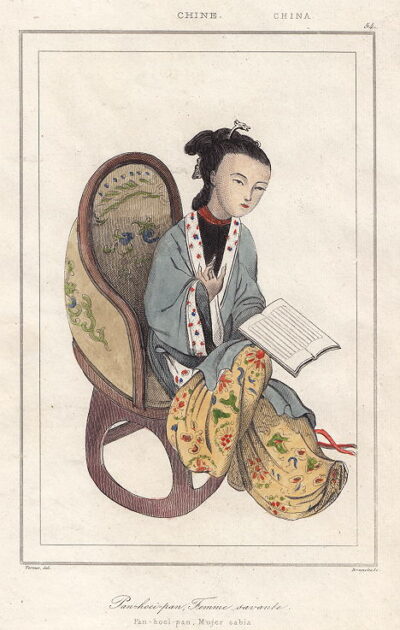
Ban Zhao
Ban Zhao was a late 1st/early 2nd century Chinese historian, philosopher and scholar. Born 45, in Eastern Han. Died 116, in Han dynasty. Known for Lessons for Women.
Facts
18 facts · 0 confirmed by two sources · 3 cited · 15 from one source
Where this comes from
Papalocal keeps its own record. It started from these sources; what each one said is kept here as it was copied, so a change on their side never changes this page by itself. Tap one to read its version.
What Wikidata says · copied November 16, 2026 · revision 2566529331
- Described as
- late 1st/early 2nd century Chinese historian, philosopher and scholar
- Other names
- Huiji, Gifted One Ban Zhao
- Born
- 45
- Died
- 116
- Born in
- Eastern Han
- Died in
- Han dynasty
- Citizen of
- Eastern Han · 1 reference
- Occupation
- historian; philosopher; writer; politician; poet · 1 reference; scholar; librarian; instructor
- Known for
- Lessons for Women
- Spouse
- Cao Shishu · 1 reference
- Father
- Ban Biao · 1 reference
- Siblings
- Ban Gu · 1 reference; Ban Chao
- Wikipedias with a page
- 47
Wikidata item Q177081 (wikidata.org/wiki/Q177081), public domain (CC0). Copied November 16, 2026.
What Wikipedia says · copied November 16, 2026 · revision 1384953974
Ban Zhao (Chinese: 班昭; 45 or 49 – c. 117/120 CE), courtesy name Huiban (Chinese: 惠班), was a Chinese historian, philosopher, and politician. She was the first known female Chinese historian and, along with Pamphile of Epidaurus, one of the first known female historians. She completed her brother Ban Gu's work on the history of the Western Han, the Book of Han. She also wrote Lessons for Women, an influential work on women's conduct. She also had great interest in astronomy and mathematics and wrote poems, commemorative writings, argumentations, commentaries, essays and several longer works, not all of which survive. She became China's most famous female scholar and an instructor of Taoist sexual practices for the imperial family. Ban Zhao is depicted in the Wu Shuang Pu (無雙譜, Table of Peerless Heroes) by Jin Guliang.
From the Wikipedia article “Ban Zhao” (en.wikipedia.org/wiki/Ban_Zhao), by its contributors, under CC BY-SA 4.0 (creativecommons.org/licenses/by-sa/4.0/). Copied November 16, 2026; not changed.
Confirmed Two sources agree. Cited One source, and it names where it got it. One source One source, without a reference of its own. Sources disagree The sources disagree. We show the best-supported value and keep theirs below.
