
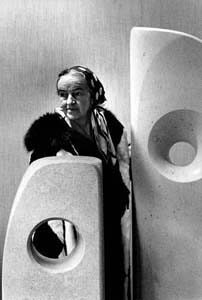
Barbara Hepworth
Barbara Hepworth was an English sculptor. Born January 10, 1903, in Wakefield. Died May 20, 1975, in St Ives. Known for Conversations with Magic Stones, Figure Three, Elegy III and Sea Form. Educated at Royal College of Art and Leeds Arts University. Awards include Dame Commander of the Order of the British Empire and Commander of the Order of the British Empire.
Facts
26 facts · 2 confirmed by two sources · 11 cited · 13 from one source
Where this comes from
Papalocal keeps its own record. It started from these sources; what each one said is kept here as it was copied, so a change on their side never changes this page by itself. Tap one to read its version.
What Wikidata says · copied November 16, 2026 · revision 2570104757
- Described as
- English sculptor (1903–1975)
- Other names
- Dame Barbara Hepworth, Mrs. John Rattenbury Skeaping, Dame Jocelyn Barbara Hepworth, Barbara Hepworth Dame, Jocelyn Barbara Hepworth, Barbara, Dame Hepworth, Mrs. Ben Nicholson
- Born
- January 10, 1903 · 20 references
- Died
- May 20, 1975 · 20 references
- Born in
- Wakefield · 4 references
- Died in
- St Ives · 3 references
- Citizen of
- United Kingdom · 2 references
- Occupation
- sculptor · 4 references; painter · 1 reference; draftsperson · 2 references; photographer · 1 reference; artist · 2 references; visual artist · 1 reference
- Education
- Royal College of Art; Leeds Arts University; Wakefield Girls' High School
- Member of
- Gorsedh Kernow (1968) · 1 reference
- Genre
- abstract art · 2 references; public art · 1 reference
- Known for
- Conversations with Magic Stones, Figure Three; Elegy III; Sea Form
- Awards
- Dame Commander of the Order of the British Empire; Commander of the Order of the British Empire
- Field
- art of sculpture
- Spouse
- John Skeaping (1924–1933); Ben Nicholson (1938–1951)
- Website
- https://barbarahepworth.org.uk/
- Wikipedias with a page
- 42
Wikidata item Q234109 (wikidata.org/wiki/Q234109), public domain (CC0). Copied November 16, 2026.
What Wikipedia says · copied November 16, 2026 · revision 1381971918
Dame Jocelyn Barbara Hepworth (10 January 1903 – 20 May 1975) was an English sculptor. Her work exemplifies Modernism and in particular modern sculpture. Along with artists such as Ben Nicholson and Naum Gabo, Hepworth was a leading figure in the colony of artists who resided in St Ives during the Second World War.
Born in Wakefield, Yorkshire, Hepworth studied at Leeds School of Art and the Royal College of Art in the 1920s. She married the sculptor John Skeaping in 1925. In 1931 she fell in love with the painter Ben Nicholson, and in 1933 divorced Skeaping. At this time she was part of a circle of modern artists centred on Hampstead, London, and was one of the founders of the art movement Unit One.
At the beginning of the Second World War Hepworth and Nicholson moved to St Ives, Cornwall, where she would remain for the rest of her life. Best known as a sculptor, Hepworth also produced drawings – including a series of sketches of operating rooms following the hospitalisation of her daughter in 1944 – and lithographs. She died in a fire at her studio in 1975.
- Born, in its opening lines
- January 10, 1903
- Died, in its opening lines
- May 20, 1975
From the Wikipedia article “Barbara Hepworth” (en.wikipedia.org/wiki/Barbara_Hepworth), by its contributors, under CC BY-SA 4.0 (creativecommons.org/licenses/by-sa/4.0/). Copied November 16, 2026; not changed.
Confirmed Two sources agree. Cited One source, and it names where it got it. One source One source, without a reference of its own. Sources disagree The sources disagree. We show the best-supported value and keep theirs below.
