
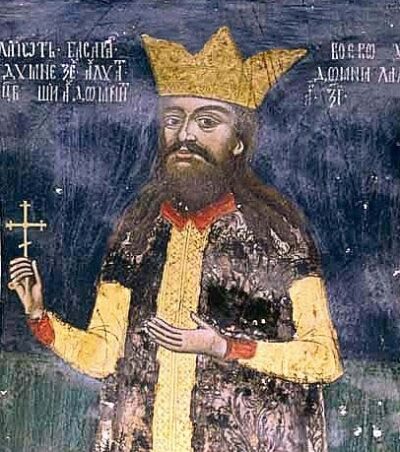
Basarab Laiotă cel Bătrân was a Ruler of Wallachia. Died December 22, 1480, in Transylvania. Positions held include lord of Wallachia (1473–1477).
Facts
8 facts · 1 confirmed by two sources · 1 cited · 6 from one source
Where this comes from
Papalocal keeps its own record. It started from these sources; what each one said is kept here as it was copied, so a change on their side never changes this page by itself. Tap one to read its version.
What Wikidata says · copied November 18, 2026 · revision 2554637916
- Described as
- Ruler of Wallachia
- Died
- December 22, 1480
- Born in
- Wallachia
- Died in
- Transylvania
- Citizen of
- Principality of Wallachia
- Occupation
- ruler
- Positions held
- lord of Wallachia (1473–1477) · 1 reference
- Father
- Dan II of Wallachia
- Siblings
- Basarab II of Wallachia
- Wikipedias with a page
- 20
Wikidata item Q2418363 (wikidata.org/wiki/Q2418363), public domain (CC0). Copied November 18, 2026.
What Wikipedia says · copied November 18, 2026 · revision 1385537564
Basarab III the Old (Romanian: Basarab cel Bătrân; died before 22 December 1480), also known as Basarab Laiotǎ, was voivode (prince) of Wallachia, ruling on five separate occasions: initially from November to December 1473, twice briefly in 1474, subsequently from 1475 to 1476, and finally for a short period in 1477. A member of the Dănești branch of the Basarab dynasty, he was a grandson of Dan II of Wallachia. His brothers, Vladislav II and Dan III, contested the Wallachian throne with Vlad II Dracul and Vlad III Dracula, members of the rival Drăculești branch, in 1447 and 1460, respectively. Basarab himself is first recorded as a claimant in 1471, when he emerged as a rival to Dracula's brother, Radu the Handsome. At the time, he was living in Transylvania, the easternmost province of the Kingdom of Hungary, but came into conflict with the Transylvanian Saxon merchants over their alliance with Radu and fled to Moldavia. There, he sought the support of Stephen the Great, who had gone to war with Radu over control of the Danubian ports.
Basarab first came to power in Wallachia following a successful invasion by Stephen the Great in late November 1473, but was forced to flee to Moldavia within a month when Radu returned with Ottoman military assistance. After an unsuccessful incursion into Wallachia early the following year, Basarab exploited Radu's illness to launch another invasion, regaining the throne by August 1474. By early September, however, he had again fled to Moldavia. Stephen restored him to power in October, but he soon faced a rival claimant backed by Hungary, Basarab the Young, another member of the Dănești branch, who defeated him and seized the throne on 20 October. The circumstances of the elder Basarab's subsequent restoration remain uncertain. Some historians maintain that he regained power with Ottoman support before the Battle of Vaslui, in which his defection contributed to Stephen's victory over the Ottomans on 10 January 1475, while others argue that Stephen restored him only after the battle.
Reports of an impending large-scale Ottoman invasion of Moldavia prompted Basarab to seek closer ties with Hungary, but in May or June 1476 he submitted to the Ottoman sultan Mehmed II. He subsequently joined the Ottoman campaign and fought alongside the sultan's forces at the Battle of Valea Albă on 26 July. Although Stephen the Great was defeated, the invaders failed to conquer Moldavia and were compelled to withdraw by famine and plague. In November, Vlad Dracula made a bid for the Wallachian throne with Hungarian support, forcing Basarab to flee to Ottoman territory. Restored to power by Ottoman backing for the last time in late 1476 or early 1477, Basarab sought a reconciliation with Hungary but was driven from Wallachia by Stephen the Great, who now supported Basarab the Young. He fled to Transylvania, from where he launched raids into Wallachia before dying in unknown circumstances.
- Died, in its opening lines
- December 22, 1480
From the Wikipedia article “Basarab the Old” (en.wikipedia.org/wiki/Basarab_the_Old), by its contributors, under CC BY-SA 4.0 (creativecommons.org/licenses/by-sa/4.0/). Copied November 18, 2026; not changed.
Confirmed Two sources agree. Cited One source, and it names where it got it. One source One source, without a reference of its own. Sources disagree The sources disagree. We show the best-supported value and keep theirs below.
