
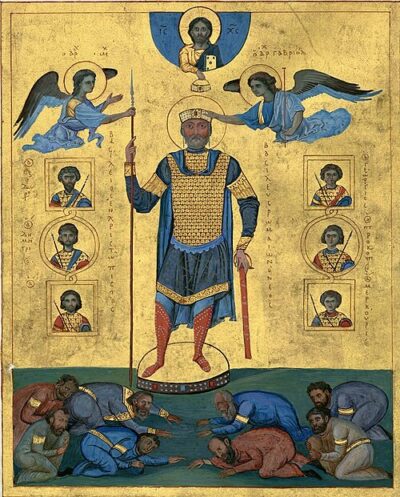
Basil II
Basil II was a Byzantine Emperor from the Macedonian dynasty. Born 958, in Constantinople. Died December 15, 1025, in Constantinople. Positions held include Byzantine emperor (976–1025).
Facts
13 facts · 2 confirmed by two sources · 1 cited · 10 from one source
Where this comes from
Papalocal keeps its own record. It started from these sources; what each one said is kept here as it was copied, so a change on their side never changes this page by itself. Tap one to read its version.
What Wikidata says · copied November 16, 2026 · revision 2569111549
- Described as
- Byzantine Emperor from the Macedonian dynasty
- Other names
- Basil II the Bulgar Slayer
- Born
- 958
- Died
- December 15, 1025 · 1 reference
- Born in
- Constantinople
- Died in
- Constantinople · 2 references
- Buried in
- Agios Ioannis Theologos, Kythnos
- Citizen of
- Byzantine Empire · 1 reference
- Occupation
- emperor · 1 reference
- Positions held
- Byzantine emperor (976–1025)
- Father
- Romanos II
- Mother
- Theophano
- Siblings
- Anna Porphyrogenita; Konstantinos VIII
- Religion
- Eastern Orthodoxy
- Wikipedias with a page
- 70
Wikidata item Q41833 (wikidata.org/wiki/Q41833), public domain (CC0). Copied November 16, 2026.
What Wikipedia says · copied November 16, 2026 · revision 1383835629
Basil II Porphyrogenitus (Greek: Βασίλειος Πορφυρογέννητος, romanized: Basíleios Porphyrogénnētos; 958 – 15 December 1025), given the epithet The Bulgar-Slayer, was the senior Byzantine emperor from 976 to 1025. He and his brother Constantine VIII were crowned before their father Romanos II died in 963, but they were too young to rule. The throne thus went to two generals, Nikephoros Phokas (r. 963–969) and John Tzimiskes (r. 969–976) before Basil became senior emperor, though his influential great-uncle Basil Lekapenos remained as the de facto ruler until 985. His reign of 49 years and 11 months was the longest of any Roman emperor.
The early years of Basil's reign were dominated by civil wars against two powerful generals from the Byzantine Anatolian aristocracy: first Bardas Skleros and later Bardas Phokas, which ended shortly after Phokas' death and Skleros' submission in 989. Basil then oversaw the stabilization and expansion of the eastern frontier of the Byzantine Empire and the complete subjugation of the First Bulgarian Empire, its foremost European foe, after a long struggle. Although the Byzantines had made a truce with the Fatimid Caliphate in 987–988, Basil led a campaign against the Caliphate that ended with another truce in 1000. He also conducted a campaign against the Khazar Khaganate that gained the Byzantine Empire part of Crimea and led a series of successful campaigns against the Kingdom of Georgia.
Despite near-constant warfare, Basil distinguished himself as a capable ruler, reducing the power of the great land-owning families who dominated the administration and military, filling its treasury, and leaving the Empire at its greatest territorial extent in four centuries. Although his successors were largely incompetent, the Empire flourished for decades after Basil's death. One of the most important decisions taken during his reign was to offer the hand of his sister Anna Porphyrogenita to Vladimir I of Kiev in exchange for military support, thus forming the Byzantine military unit known as the Varangian Guard. The marriage of Anna and Vladimir led to the Christianization of the Kievan Rus' and the incorporation of later successor states of Kievan Rus' within the Byzantine cultural and religious tradition. Basil is seen as a Greek national hero but is a despised figure among Bulgarians.
- Born, in its opening lines
- 958
- Died, in its opening lines
- December 15, 1025
From the Wikipedia article “Basil II” (en.wikipedia.org/wiki/Basil_II), by its contributors, under CC BY-SA 4.0 (creativecommons.org/licenses/by-sa/4.0/). Copied November 16, 2026; not changed.
Confirmed Two sources agree. Cited One source, and it names where it got it. One source One source, without a reference of its own. Sources disagree The sources disagree. We show the best-supported value and keep theirs below.
